


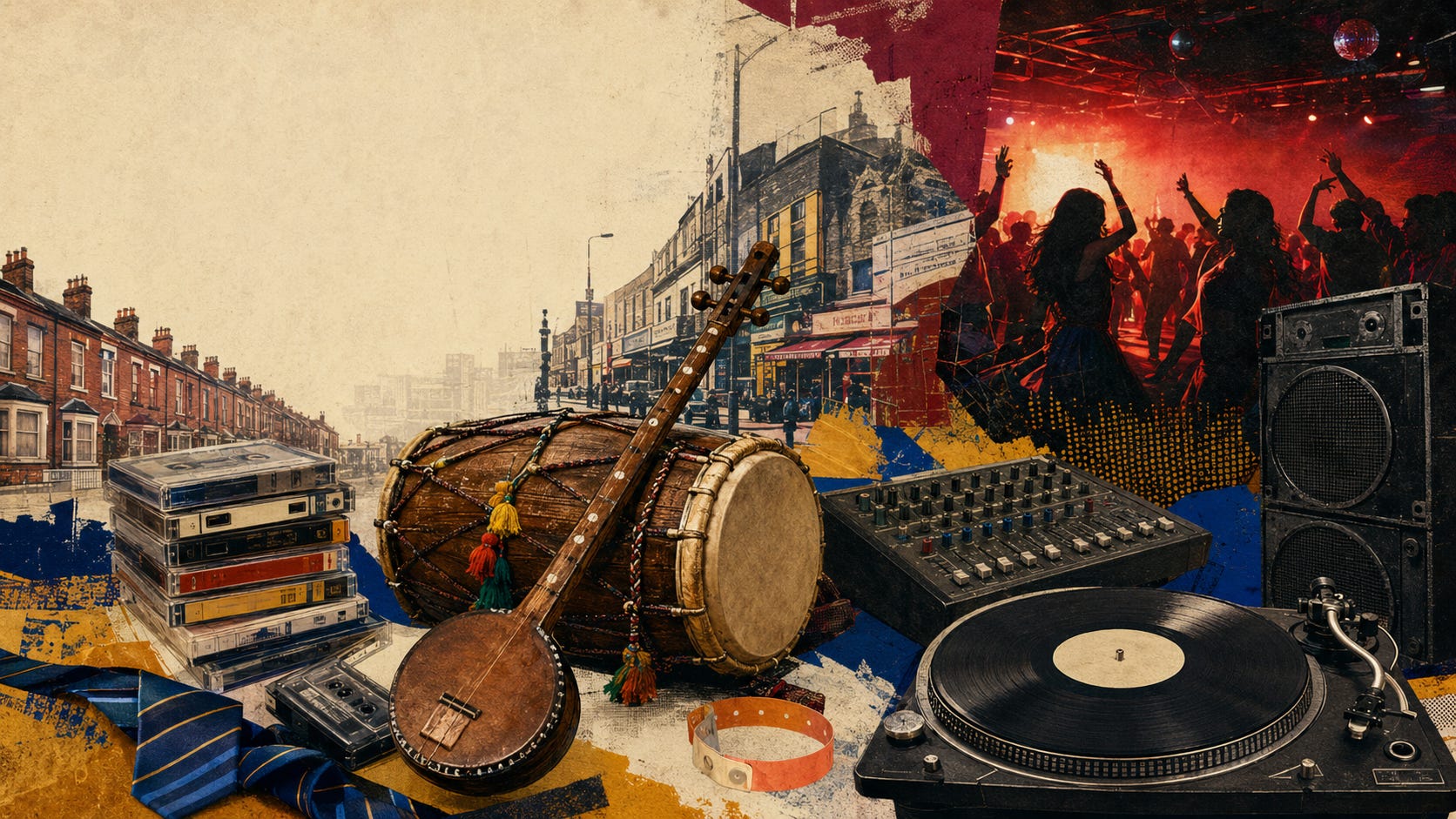
A large part of my Punjabi playlist sounds, well, not Punjabi. It starts with a tumbi, drops into a reggae bassline, swerves through an R&B chorus and occasionally contains a man rapping in a combination of Punjabi, English and Jamaican patois. Occasionally, a tappa slinks in and a jhanjhar shimmers in the background. It shouldn’t work, but it does!
Apache Indian. Bally Sagoo. Panjabi MC. Rishi Rich. Juggy D. Jay Sean. Dr Zeus. RDB. Sukshinder Shinda. Songs that still make a room move within four seconds. Get any thirty-something desi to hear aaja mahi aaja mahi aa sohneya ve… and they will start shimmying, no exceptions. Songs that sound, even now, like someone has opened five different doors at once and somehow let the same party through all of them.
The story we tell of Punjabi music going global has a bunch of familiar, contemporary names. Sidhu Moosewala was a phenomenon in how his verses went global. AP Dhillon and Gurinder Gill made music created for streaming. Diljit Dosanjh walked onto the Coachella stage in a turla and a black kurta and announced that Punjabi aa gaye oye! All of this is true, and the kind of global love these artists have created is undeniable. But it’s unfair to give them all the credit for this because Punjabi music had gone global once before. That music came from Handsworth, Southall, Coventry, Bradford and Leicester, where the children of Punjabi migrants grew up hearing tappe and filmi music at home, reggae and soul from the house next door, American hip-hop on imported tapes, and British rave music in clubs that did not always want them there.
For roughly two decades, Britain produced some of the most inventive Punjabi music in the world. It had bands and producers, singers that got mobbed when they went grocery shopping, specialist labels and record shops, weddings that functioned like touring circuits, people who crashed said weddings just to gear the music, pirate radio, daytime raves, international stars and an audience that could sustain a parallel economy.
So, where did it go? Why do we still bop to Kangna and Aaja Soneya without a clue about where Dr. Zeus or Bally Saggoo are today? What happens when there is a gap between the cultural, commercial and institutional power accrued by a scene? What falls through the cracks?
Come, let’s find out.
The myth of ‘fusion’
The word fusion (as we know it now, in its commercially sanitized avatar) makes me imagine a record executive sitting with a whiteboard behind him and a shit-eating grin on his face. One side, Afro-Caribbean audience; the other side, Punjabi audience. Add a reggae beat here, add a Punjabi tumbi here, and bam, we double our commercial capacity. And that is how fusion works today as a strategy, of course. The idea is that you bring two disparate cultures together and you mesh them to consolidate their audience and to give people a reason to double their streams. The goal is to simply find how two audiences can be commercially useful to each other.
That is not how British Bhangra fusion emerged. It emerged because of real, lived experiences. In Birmingham, for example, Punjabi and Caribbean families were sharing neighborhoods, schools, high streets, clubs, and grocery stores. They were also sharing the experience of being treated with incredible hostility in a foreign country where you are permanently treated as the other. What didn’t help either was that the first-gen immigrants who came in were incredibly wary of each other. They did not intermingle. In Punjabi, there’s this phrase called “roti beti ka sambandh,” which basically says that these are the people we will share food with and marry our daughters to. Do you think that existed for these two communities? Of course, it did not.
Between these racial and cultural tensions, Handsworth was already home to one of Britain’s most important reggae cultures. Whether you think of Steel Pulse or UB40, Sound System culture was not an exotic other. It was what the second-generation kids were discovering and trying to reconcile with. These kids were definitely not Indian because they were born and brought up in Britain. They were also definitely not British because they were being othered. Who did they look for? They looked for each other as both inspiration as well as belonging.
Steven Kapur, who we know better as Apache Indian, grew up in Handsworth and followed his Afro-Caribbean friends into reggae. He worked with local sound systems before making the music that would eventually become known as Bhangramuffin, which was reggae and dancehall structures that carried Punjabi rhythms and ways of speaking. Years later, when asked about his inspiration for this “fusion,” he said that when he entered a studio, he did not want the music to only be reggae, so they added a Punjabi rhythm, which was “just like their lifestyles.” You can hear the same instinct in Bally Sagoo. He was raised in Birmingham on soul, reggae, hip hop, and Motown, and initially found the kind of Punjabi and Indian music he heard at home too flat for the clubs that he frequented. He began rebuilding it: Hindi and Punjabi vocals laid over deeper bass, programmed drums, dub, space house energy, building the kind of rhythmic beat quality that he, as a DJ, would need to spin in a club.
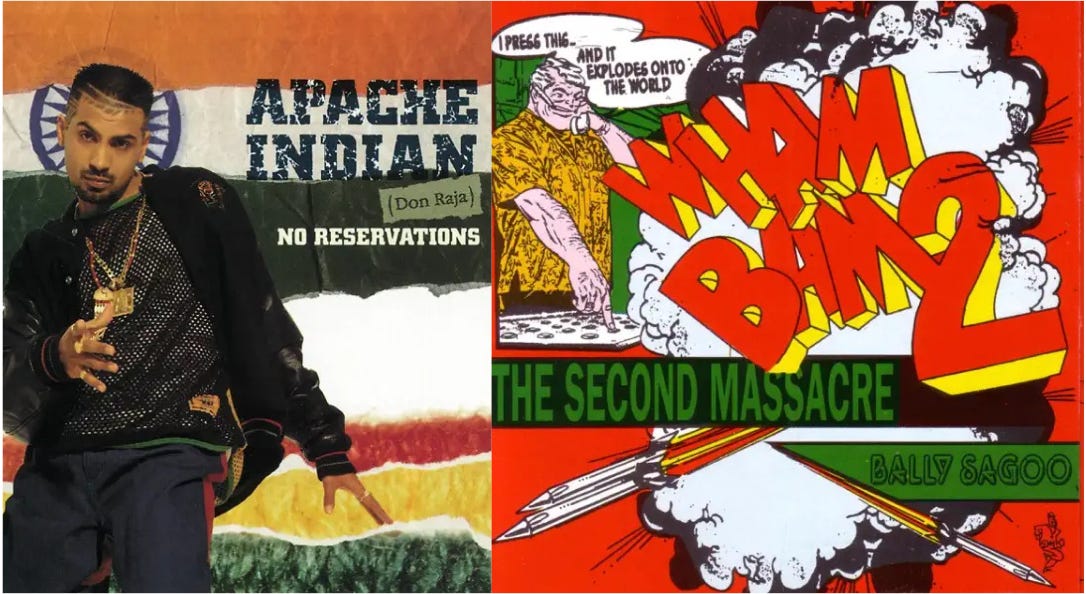
There was no grand ambition surrounding ‘preserving folk forms’ or ‘protecting heritage.’ Sagoo treated Punjabi music like living material (which is exactly what it is!) He stretched it, sampled it, tightened it, pulled the voice away from the original arrangement, and gave it a completely new body. Punjabi MC did something similar through hip-hop. Rajinder Singh Rai grew up in Coventry, listened to the music his parents loved while trying to capture American rap from the radio. He once sent someone to London with a ghetto blaster to record a Tim Westwood show, practiced his Punjabi music at a Caribbean social club, sand saved wages from a clothing factory to beuild his own production setup because nothing else would allow him to bring his vision to life.
This is why the best records from that period still feel coherent even when the list of influences sounds ridiculous. Reggae, ragga, bhangra, house, jungle, UK garage, hip-hop, R&B, Hindi film music, synthpop. On paper, it can look like too much. When you hear it, though, it makes sense. It is good music! The kids making it were not switching identities every time the beat changed. Their lives already contained all of those things, so naturally their music did too. That did not make it any less Punjabi.
The party had to happen at two in the afternoon
While music itself is intangible, it requires a tangible space to be tested in. It needs an audience in front of which a song can fail, can be remixed, can be demanded again. It has to become attached to a particular ecosystem, to a particular circumstance. That, for British Asian teenagers in the 1980s and the 1990s, was often at the Daytimer.
To understand the history of the daytimers, one must go back to the incredible immigrant anxiety that first-generation immigrants felt over their children becoming “westernized.” Young people’s parents would not allow them to go clubbing at night because they didn’t want to allow them to become “white.” What ended up happening was ingenious and slightly silly. Kids left home claiming they were heading to school, changed elsewhere, travelled by train to different cities to dance for several hours and returned home in time for dinner. The events spread through London, Birmingham, Bradford, Nottingham, Manchester, Leicester, Luton, and beyond. Some, in fact, drew thousands to become a very enmeshed part of British identity.
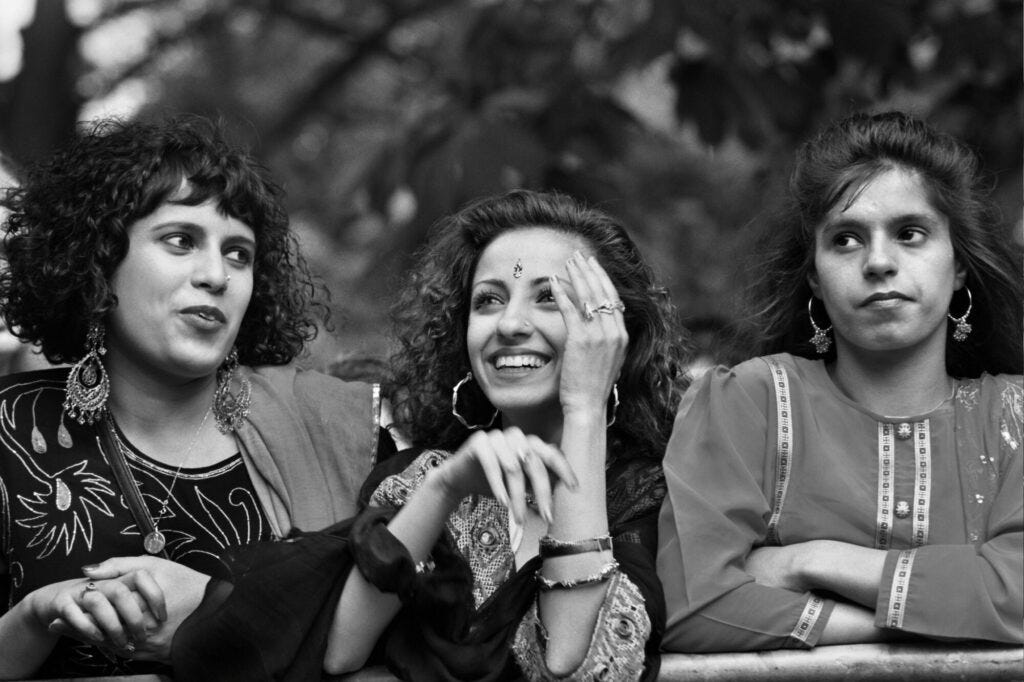
The history of the daytime was obviously focused on secrecy and freedom. For young women in particular, these afternoons offered access to public pleasure under conditions that were otherwise very, very heavily monitored. They could dress as they wanted, meet boys, dance, and occupy public space without being constantly surveilled. These parties, of course, were not uncomplicated. Many were marked by inter-school and inter-religious violence, and community groups became incredibly territorial about who went inside. Despite all of that, they created a rare space where British Asian youth could see themselves as part of something larger than the sum of the anxieties that their parents felt about them growing up in Britain. This, of course, created space for music.
Promoters need venues. DJs need records. Audiences need belonging. Which meant that the daytime venues became the perfect space for this new fusion to be tested out. Record shops became ticket counters and information networks. A song that worked in Luton went ahead and traveled to Birmingham. Producers could hear what was the audience’s reaction in real time.
One does not need to romanticize the daytimers to acknowledge the impact that they had. They worked through unfair restrictions, very real racism, and intense family surveillance, but if you cannot be out at midnight, a rave at 2:00 in the afternoon starts to make sense. If the main clubs will not play your music, you hire the same clubs before the dark and play it yourself. The audience, the venue, the information network, and the testing grounds were all built in parallel. When we talk about representation now, we mostly mean seeing a brown face that looks like us on a mainstream stage. Representation can also mean building a stage of your own because the existing one has no place for you, and that is exactly what the Daytimes did. They did not wait for British nightlife to recognize British Asians as a desirable customer. They created their own parallel “nightlife” in the middle of the day, and because it was parallel, it became stomping grounds for experimentation that would have otherwise taken years to become commercially viable.’
The dancefloor was full of women. The stage was not.
Go back and reread the list of names I opened this essay with. Apache Indian. Bally Sagoo. Panjabi MC. Rishi Rich. Juggy D. Jay Sean. Dr Zeus. RDB. Sukshinder Shinda. Every single one of them is a man. That is not because women were absent from British bhangra. They were dancing to it, requesting it, promoting parties, coordinating alibis, singing on records and, occasionally, standing behind the decks. But when the scene turned all that cultural energy into careers, catalogues, money and names people would remember thirty years later, the default beneficiary was still a man.
The Daytime raves existed in large part because young women needed an outlet, and they were the ones that championed it. They were simultaneously the scene’s most committed and most surveilled audience, and none of them ever got to be on stage. The same family and community scrutiny that pushed parties into the afternoon made a daughter with a microphone anathema to most households. A stage meant public visibility, especially as an entertainer. If you look at Indian/Punjabi terms for entertainers, nachaniya, nautanki, jamoora, there has always been a classist and casteist lens attached to the profession. You also have to remember that the two majority castes from Punjab in Britain at this point were the Jatts and the Ramgarhias, both of whom had a very strong sentiment against “their” women being available to the public.
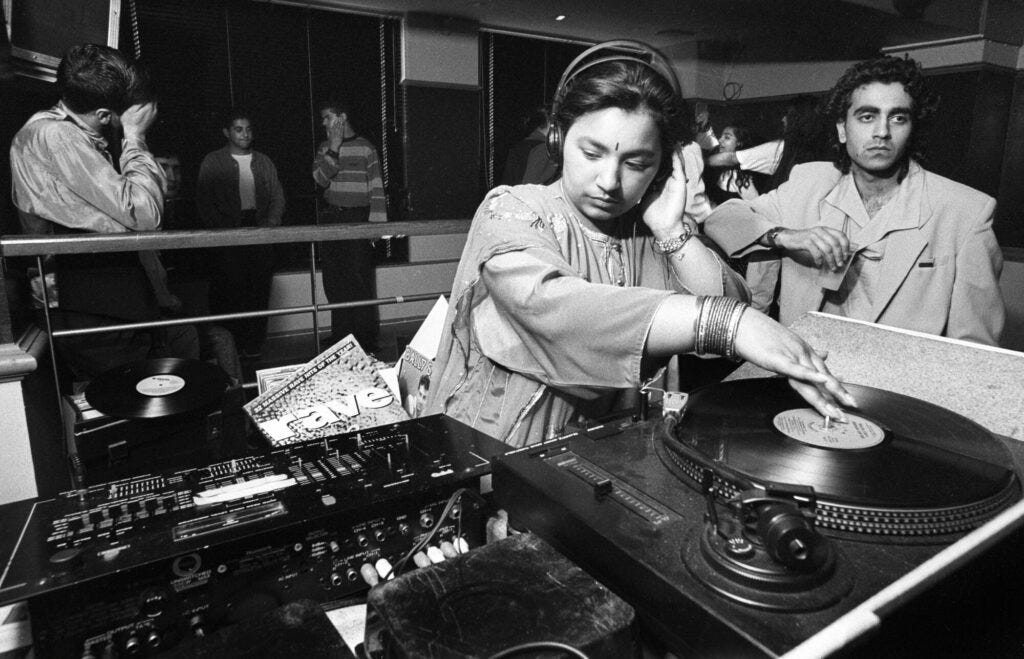
It would be wrong, however, to say that no women made it onto the stage or behind the decks. Rani Kaur, better known as DJ Radical Sista, was playing Bradford daytimers by the end of the 1980s. DJ Ritu became a pioneer of the wider bhangra and Asian Underground scenes. Sweety Kapoor was another important figure in the club culture that followed. Their existence does not weaken the argument. It makes the real problem clearer. Women could participate, organise and occasionally become visible, but the scene did not produce a comparable pipeline of women who were recorded, marketed, managed and allowed to compound their success.
Hard Kaur is a name I will evoke here. She grew up in Birmingham, came through the same city that produced Bally Sagoo and Apache Indian, and became one of the first British-Indian women to build a serious career in rap. “Ek Glassy” had already found an audience in Britain, but it was Mumbai, and eventually Bollywood, that gave her access to mass scale. The irony is difficult to miss. Britain helped make Hard Kaur, but she had to enter the Indian film industry before she could become a mainstream star.
You could sell tens of thousands of cassettes and still not exist
In 2002, a Guardian survey of Britain’s regional music scenes described Birmingham Bhangra as a parallel music universe. A specialist label executive estimated that major Bhangra albums could sell 100,000 copies even before piracy could be considered. They could sell huge numbers through Asian music shops, grocery stores, market networks, and weddings.
What ended up happening was that these sales moved through commercial value chains that were not counted by the national chart system, while mainstream chains did not stock the records at all. It may have been Britain’s ultimate underground scene, but it was simply segregated and uncounted. The roots of that economy went back decades. Before the producer era came the bands. You had bands like Alaap, Heera, Premi, Apna Sangeet, DCS, and others who turned Punjabi folk and medding music into a distinctively British live format. Drum kits and synthesizers were introduced. In fact, they inspired legends in return too (as Nusrat Fateh Ali Khan engaged with the British audience more, synthesizers and steel drums entered his arrangements).
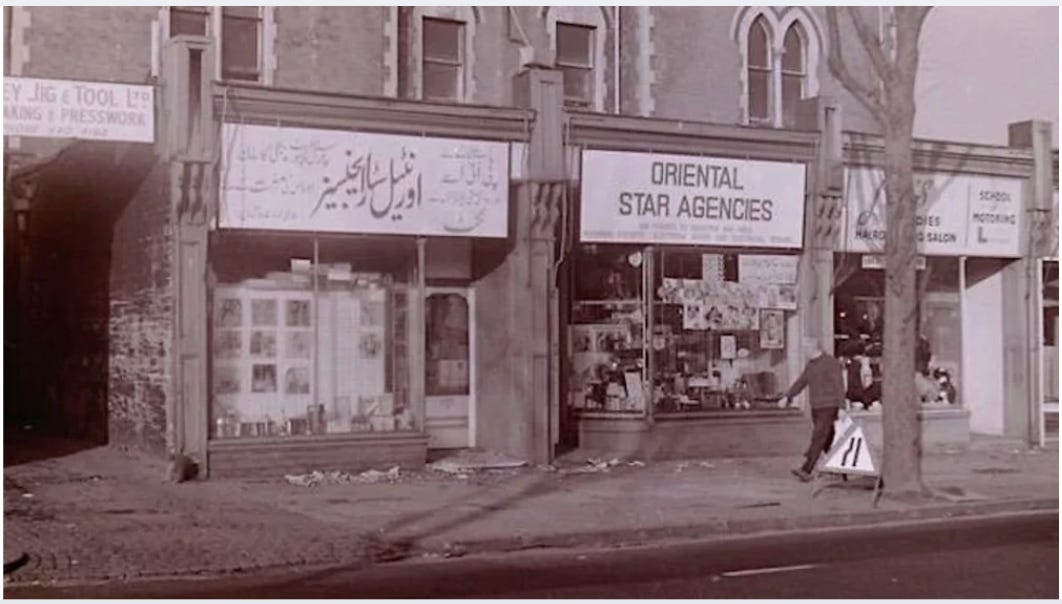
Labels grew around them. Orient Star Agencies began with Muhammad Ayub importing records for immigrant communities who could not find the music from home that they missed. In 1969, after being approached by the Bhujangy group, the business began releasing records too. It went on to become the foundation of British South Asian music, supporting artists like Malkit Singh, Bally Sagoo, and NFAK The story of OSA is the story of immigrants building missing markets for themselves. Multitone, founded in the 1970s, became another major home for British Bhangra; Fantronic, Nachural, Moviebox and later 2Point9 formed pivotal nodes too.
The industry operated outside standard systems used by the British Phonographic Industry. Sales were incredibly difficult to verify. Publishing rights were inconsistently registered. Cash payments and full buyouts were incredibly common. Artists could make records that went ‘viral’ without receiving a transparent account of how many copies were being sold. Rights that should have produced income over decades were often surrendered in the beginning simply because nobody knew how to consolidate the ecosystem around the artist.
For a moment, the ceiling kept rising
What makes the story more frustrating is how close the scene came, repeatedly, to breaking through the mainstream.
Apache Indian signed to Island in the early 1990s. “Arranged Marriage” reached number 16 on the UK singles chart and the Nuff Vibes EP, led by “Boom Shack-A-Lak”, reached number five. Bally Sagoo signed with Sony. “Dil Cheez” reached number 12 in 1996. In 1999, Talvin Singh’s OK won the Mercury Prize. He belonged to the adjacent Asian Underground rather than the bhangra scene itself, and his music moved through Indian classical, drum and bass, ambient music, jazz and electronica, often in more art-house spaces. But the win still felt like a door opening. Singh described it at the time as a sign that he was “not a minority any more”. For a brief period, it seemed as though the industry might finally understand this music as something central rather than peripheral.
Then came Panjabi MC. “Mundian To Bach Ke” had first appeared years earlier, but its European release in the early 2000s turned it into something else. A Punjabi folk vocal by Labh Janjua sat over the Knight Rider theme, filtered by a producer who understood both hip-hop sampling and what a dhol-driven beat could do to a dancefloor. It reached #5 in Britain. Jay-Z appeared on a remix. A mostly Punjabi-language song travelled across the world and people who didn’t know what Punjabi was grooved to it. I remember being in a club in Shanghai in 2019 and, as soon as the Chinese DJ saw me on the floor, he started playing this song. It was the only non-English or Chinese song he played that night. Cool, huh?
Then, in 2003, the Rishi Rich Project released “Dance With You (Nachna Tere Naal)”. Rishi Rich produced, Juggy D owned the Punjabi vocals, Jay Sean carried the R&B line, and the record moved between languages seamlessly. It reached number 12. Jay Sean’s “Eyes on You” would reach number six the following year; “Stolen” reached number four.
Rishi Rich was one of the foundational creators of this era. He was a producer capable of creating a recognizable, cogent sound across performers without forcing anyone to compromise on their style. 2Point9 offered an all-in-one British Asian entertainment structure. Relentless and Virgin provided major-label reach. This is the moment people forget when they describe early British Asian pop as a collection of charming crossover experiments. The songs charted. The artists signed major deals. The audiences existed globally. The scene was not a blip in time. It had all the elements of success available to it!

The biggest British film in the world
In 2002, Gurinder Chadha released Bend It Like Beckham. A film about a Punjabi girl in Hounslow who wants to play football became one of the most profitable British films of its era. It grossed tens of millions worldwide and crossed into American cinemas in the spring of 2003, the same season “Mundian To Bach Ke” was tearing through the British charts. For one moment, a Punjabi song was in the UK top 5 and a Punjabi family from West London was one of Britain’s biggest cultural exports. And the soundtrack was the scene. B21. Malkit Singh. Bally Sagoo.
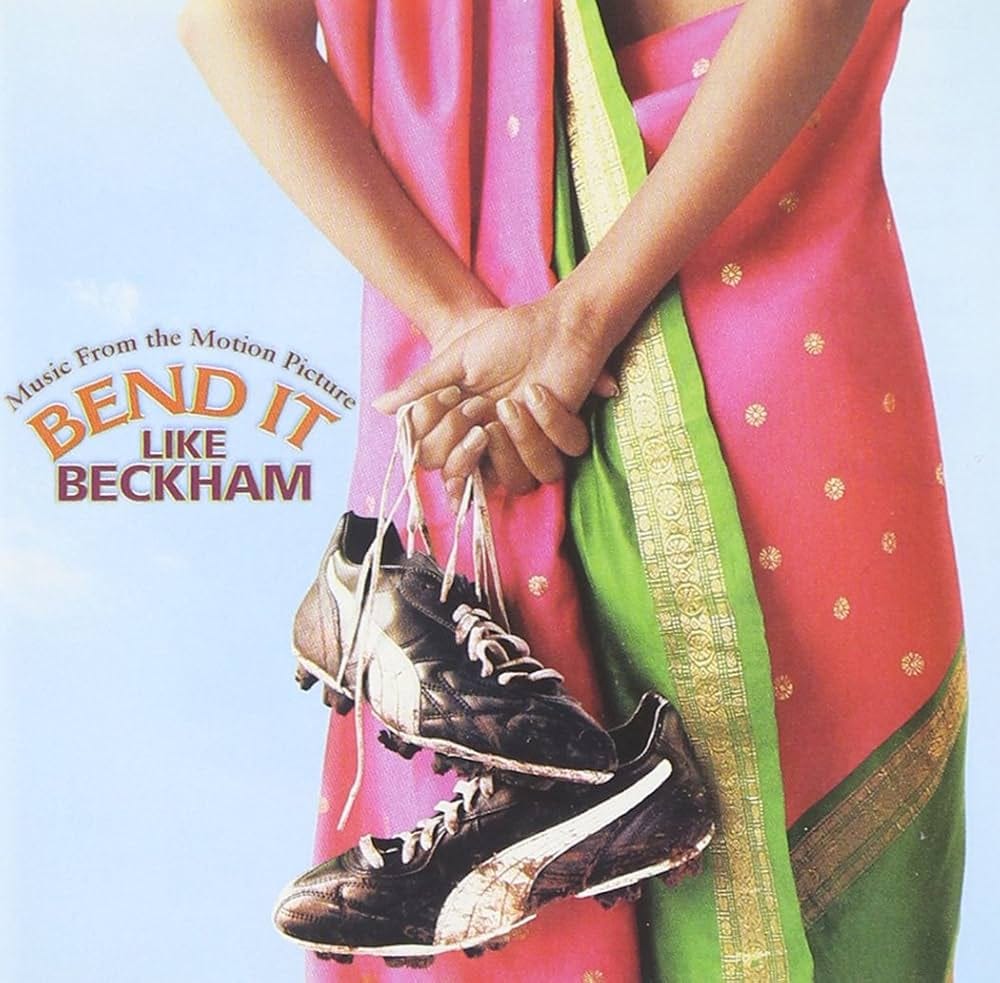
Nor was the film an isolated event. Goodness Gracious Me had run on the BBC from 1998. The Kumars at No. 42 launched in 2001 and sold internationally. East Is East was a critical and commercial hit in 1999. Between late 90s and early 2000s, British Asian culture peaked across television, film, comedy and music at the same time. Then, across all of those formats, it receded at roughly the same time too.
A scene is not the same thing as an institution
This is where cultural histories often become frustratingly vague.
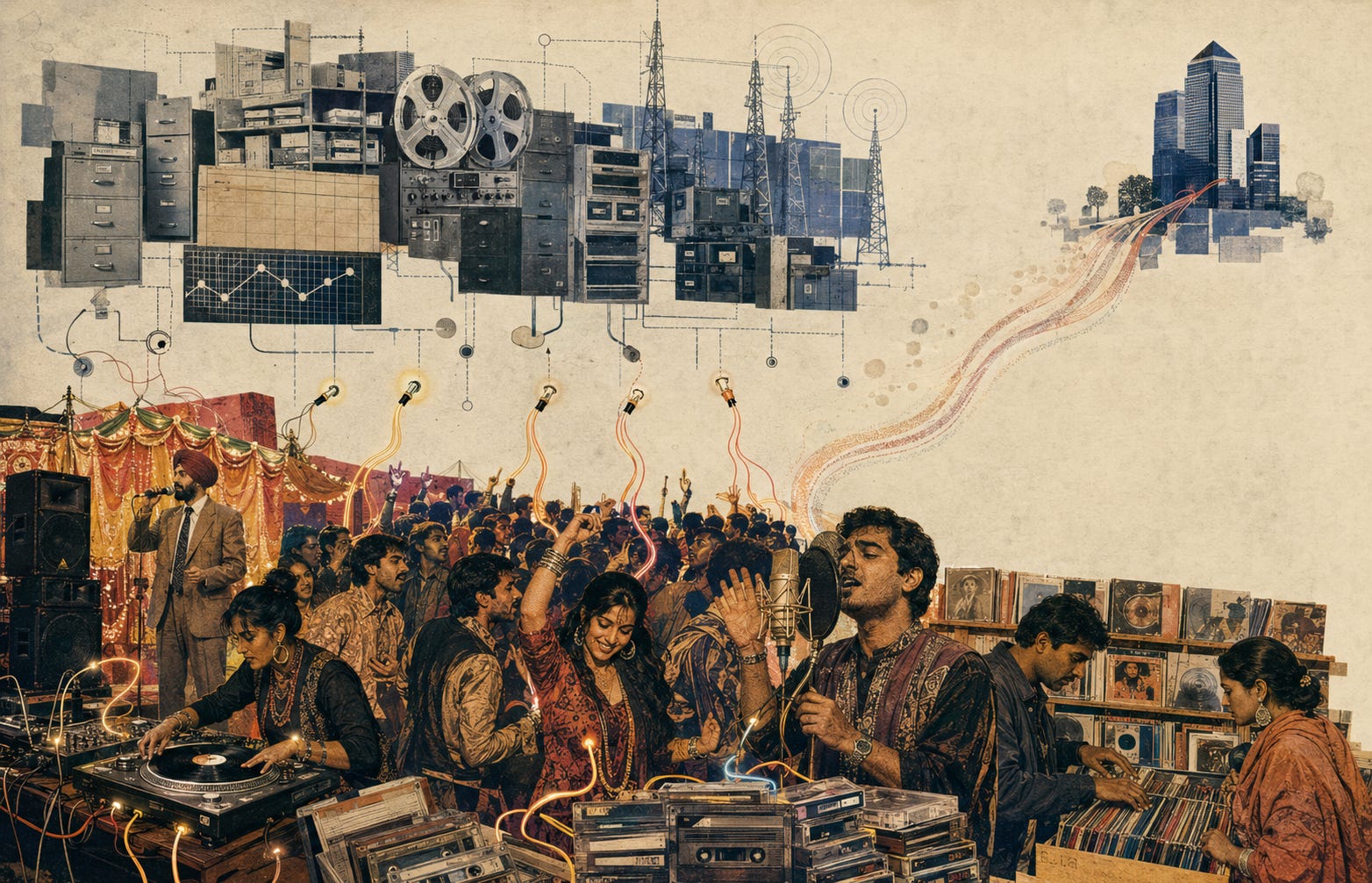
Institutions are, for all their evils and faults, bulwarks against which trends can lean on. Someone has to find the next artist before the current one stops charting. Someone has to account for the publishing numbers, know where the masters are, collect royalties across territories, and train the managers, producers, A&R executives, lawyers and promoters who understand the market. Someone has to pay attention to audience behaviour and use that data to guide creators and artists. The success of one act should make it easier to finance five more. The catalogue should keep earning. Ideally, some of that value should stay with the people and communities that created it.
The mainstream labels tended to treat British Asian performers as individual exceptions instead of part of a pipeline. Apache Indian’s deal did not become an Island pipeline for the next generation of bhangramuffin or Punjabi artists. Bally Sagoo’s success did not turn Sony into the institutional home of British South Asian production. Talvin Singh’s Mercury Prize did not make the Asian Underground a permanent category of British investment. Jay Sean’s Virgin deal did not produce ten more Jay Seans.
Britain built one formal institution for this audience. The BBC Asian Network went national in 2002, at the exact peak of the culture’s visibility, growing out of local programming that had served Midlands audiences since the late 1980s. It gave the music national airplay, gave the scene professional broadcasters, and gave a generation the experience of hearing their own languages on a national frequency. Within eight years, the BBC proposed shutting it down. The station was reprieved after a public campaign, with its budget slashed, and it has spent most of its existence since then fighting for survival. It is difficult to compound very much value when the institution itself is perpetually on probation.
The independent labels did immense cultural work, but many were operating inside a market deformed by uncounted sales, piracy, weak rights enforcement, informal accounting and limited access to mainstream distribution. They were being asked to build for the long term while constantly solving for short-term survival. Eventually, much of the value collected in catalogues moved upward.
Oriental Star Agencies operated for more than fifty years. Its catalogue contained around 18,000 songs, concerts and video recordings. In 2024, Universal Music Group announced that it had acquired the complete catalog, including recordings and, where held, publishing rights.
There is nothing overtly sinister about a catalog acquisition, obviously. A global company can restore, revive, distribute and introduce old music to audiences an independent owner may struggle to reach. But the symbolism is difficult to miss. A community built a musical archive because the mainstream did not consider that music worth serving. Decades later, after the global market had demonstrated how valuable South Asian listeners were, the archive became a growth asset for the world’s largest music company. This is what I mean when I say the music was commercially orphaned. Obviously, people made money. But how much of it went back to the people who created the music itself?
Jay Sean and the price of becoming visible
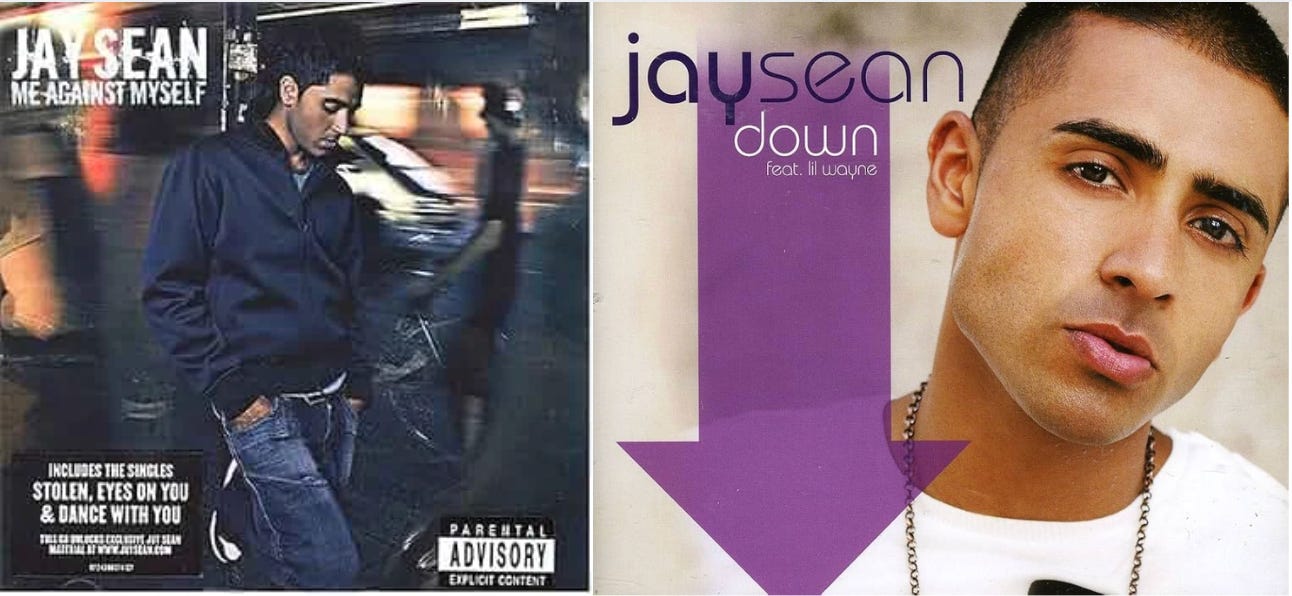
The tragedy of Jay Sean (if you can call being a smoking hot superstar a tragedy) is a microcosmic lesson. His early success was unmistakably rooted in British Asian music. Me Against Myself straddled R&B, hip-hop and South Asian production inside the same pop identity.
Then came “Down”. Released after Jay Sean signed with Cash Money, featuring Lil Wayne, the song reached #1 on the Billboard Hot 100 in 2009. It made him the first solo artist of South Asian origin to top the chart. It was a genuine, enormous achievement. It also contained no identifiable Punjabi musical DNA.
Jay Sean, of course, did not owe anyone a lifetime of tablas and tumbis. South Asian artists should be allowed to make ordinary pop, bad pop, brilliant pop, music about nothing, music that refuses to carry an entire civilization debt on its back. White singers are not asked to insert a folk instrument or Bible verse into every chorus to prove they remember where they came from. But the difference between the two stages of his career still tells us something about the market around him.
Jay Sean has said that looking back, when he first entered the mainstream he felt he had “no choice but to sing in English” because Punjabi from a Punjabi performer would have been more alienating. He found ways to hold onto his roots in the arrangement instead: a Bollywood sample, Eastern strings, an Indian flute.
We often celebrate the first person from a community who succeeds in a mainstream institution as proof that the door is finally open. Occasionally it is. But a successful individual can also be absorbed into an industry without the industry becoming meaningfully more interested in everyone else who looks and sounds like them. One person’s visibility can comfortably conceal an industry’s larger disdain.
By the end of the 2000s, the British Punjabi ecosystem no longer felt like the centre of the future. Some of its producers moved into Bollywood. Some artists continued making music for loyal audiences. British Asian musicians entered grime, rap, garage and mainstream pop through other routes. The local scene did not vanish, but it stopped carrying the simmering potential of a global legend being created.
The centre moved to a corridor, not a country
I could end the next section in basically 4 words: Britain failed. Canada succeeded.
That would be a gross simplification.
The modern Punjabi music economy is not simply Canadian. It is a corridor running through Punjab, Toronto, Brampton, Surrey, Vancouver, Chandigarh, Mohali, London. Artists are born in one place, raised in another, blow up with a single recorded on their phones, scrounge up money to fly down to Toronto, record across several countries, get introduced to produces like Desi Crew who ‘initiate you’, and then release to a market that does not experience those borders as separate. An early example of this is Jazzy B, who born in Punjab, raised in Surrey, shaped professionally through Birmingham and closely associated with Handsworth producer Sukshinder Shinda.
The British wave was built through physical proximity: Punjabi and Caribbean families sharing streets, schools, studios and clubs. The new wave was built through a different kind of proximity, one created by migration routes, cheap production software, YouTube, streaming platforms, group chats and a global Punjabi-speaking public able to hear a record at the same time. That changed the power relationship.
A British Asian artist in the 1990s often needed national radio, chart-return shops, a major distributor or a crossover press narrative to become “available” outside the community. A Punjabi artist in Canada could upload a song on YouTube and Spotify and reach Punjab directly. An artist in Punjab could build a Canadian audience without first being selected by Canadian radio. The diaspora was no longer only the market at the edge of an Indian release. India and the diaspora were listening together.
Spotify reported that four of India’s ten most-streamed songs in 2022 were Punjabi. “Excuses” by AP Dhillon, Gurinder Gill and Intense was the most-streamed song in the country, while Sidhu Moose Wala’s Moosetape was the most-streamed album. Punjabi had become one of the platform’s most-streamed music languages in India, alongside Hindi and English.
For decades, one obvious route to scale for Punjabi music was absorption into Hindi cinema. This generation showed that this was no longer the only way to reach a mass audience. AP Dhillon and his collaborators released through Run-Up Records before larger companies arrived. Sidhu Moosewala increasingly released work independently. Neither needed to dilute the music before allowing it to travel.
AP has been unusually direct about the ownership question. Explaining why he had turned down film offers, he argued that an artist could accept the budget and promotional machine, but would often lose control of the record. “Sometimes, you have to eat less to bring change,” he said.
What the hell is ‘pure Punjabi’?
There could be an argument made about the “purity” of Punjabi music today, which is distinctly Punjabi, doesn’t have an English bridge, and does not let go of or dilute the Punjabiness of the music to retain a listener. In the British era, hybridization was interpreted as a bridge to the mainstream. The closer an artist moved towards British or American pop, which was a lot more familiar to the audience, the easier the industry found it to essentially acknowledge and embrace the artist. The current wave, however, can borrow from everywhere and still behave distinctly Punjabi. It does not need the collaboration on an English chorus to make the listener care. It is, in colloquial terms, sone pe suhaaga. Take the example of Diljit collaborating with some fantastic global artists, most notably Sia. He doesn’t need Sia to be relevant to his listeners. Sia doesn’t need him either. This is a collaboration on deeply equal footing. The industry has definitely noticed. In 2023, Warner Music Canada and Warner Music India launched 91 North Records, a JV led by Ikki and designed explicitly to connect South Asian artists and audiences across the Indo-Canadian corridor. Its first signings included Karan Aujla and Jonita Gandhi. Warner itself spoke about Punjabi music in glowing terms, talking about how it was moving from a regional interest to a global force.

That is definitely progress and something worth being proud of, but again, let’s ask the questions that British bhangra forgot to:
Who owns the masters?
Who owns publishing?
Who develops the next artists?
Who has decision-making authority on the current creators after they stop charting?
Does this movement create instability?
Do they have institutions that protect the creators of the music, or is it a replication of the same exploitative structure that eventually led to the British bhangra downfall?
These are not hypothetical questions. The new corridor has already been forced to answer a few of them. When Moosewala was murdered in May 2022, he was the most powerful independent artist the wave had produced. Within months of his death, his catalog became contested ground. His family fought publicly over posthumous releases and went to the press with questions on the rights to what he had left behind and the existing catalog, which did not have clear ownership yet. The power that Moosewala accumulated did not survive him. The fact that he was independent, which was a great thing while he was alive, left his family vulnerable. Down the line, they are still struggling with the aftermath of the financial cost of the legal battle that they had to fight.
Major labels are not automatically evil or automatically virtuous, and independent labels are not automatically the heroes. Plenty of independent artists are exploited by small operators, and plenty of major deals can be incredibly helpful to artists. The lesson here is that visibility cannot, in and of itself, be the goal. It has to be backed by ownership as the final outcome.
The Party Never Stopped
There is a new British South Asian club culture now. The ‘Daytimers’ name has been revived by a younger collective. DJs and producers are placing Punjabi folk, Bollywood, garage, jungle, bass and electronic music into rooms that are more intentionally inclusive of women, queer people and South Asian identities beyond the old Punjabi centre. Yung Singh’s sets travel online in ways the original daytimer DJs could not have imagined. The energy is alive again.
That matters because nostalgia can become another way of refusing to build. It is easy to turn the old UK scene into a playlist of bangers and a few grainy photographs. It is easy to congratulate ourselves for how ahead of its time everything was. It is harder to ask why being ahead of its time produced so little durable leverage for the people who made it.
The old scene deserves more than sentimental rediscovery. It was a serious cultural and commercial achievement. It changed what Punjabi music could sound like. It gave second-generation British Asians an identity of their own. It showed that Punjabi lyrics could travel without becoming a joke or an anthropological exhibit. It influenced the production vocabulary that later moved through Bollywood, British pop, global hip-hop and the Punjabi Canadian wave. It built labels when nobody would distribute the music, parties when nobody would host the audience, shops when nobody would stock the records and stars before the charts knew how to count them.
And it left us with a lesson it never intended to teach. Culture does not automatically become power simply because it is brilliant. A community can create a sound, find an audience and produce a global hit without retaining enough of the value to decide what happens afterwards.
Punjabi music went global twice. The first time, a generation in Britain proved that it could sound like the whole world and remain unmistakably Punjabi. The second time, a network running through Punjab and Canada proved that it no longer needed to ask the world to recognise it first. The difference was leverage.
That is why the British moment feels so exhilarating to revisit and so frustrating to understand. You can hear the future being invented in those records. You can also hear how little of the future belonged to the people inventing it.
Hi @Harnidh Kaur, I’ve followed you for a long time and have always been fond of your writing. I’ve recently started sharing my own ideas. Would love for you to checkout and share any suggestions:
https://creditriskandme.substack.com/p/the-art-of-taking-yourself-back?r=82bvtw&utm_medium=ios (On procrastination)
https://creditriskandme.substack.com/p/dhh-review-02-ogs-aushadhi-ad9?r=82bvtw&utm_medium=ios (On a song track)
Brilliant write up. Next, may be an article on evolution of Punjabi Cinema?!