


My book, The Girls Are Not Fine, is now available for preorders! Get your copy here.
I’ve been thinking about marriage the way I think about my career recently. I’m in my thirties. The people around me are either getting married for the first time or, increasingly, getting divorced. The ones who are happily partnered have this ineffable quality of settled energy that I find myself studying the way I study a series C pitch deck: what decisions led to this outcome? What was the initial pitch? What was the founder impetus? What was the key insight? What did they know that the others didn’t? Is it replicable, or was it luck?
I’m not someone who dismisses marriage as a trap or romanticises it as a destination. I think it is a decision, probably the most significant one most women will ever make. I’ve started to believe it deserves at least the same rigour we’re supposed to bring to every other consequential choice in our lives. Not because love doesn’t matter, but because love without discernment increasingly feels like a terrible decision to take.
So I did what I always do when a question is keeping me up at night. I went looking for data.
I reached out to thirty women in my life. The criteria: These had to be women I know but not well enough to know their husbands, they have to be women I look up to, these have to be women I respect, women whose careers I admire, women who seem to genuinely like their husbands when they talk about them, and I asked them two questions. What keeps your marriage alive? And what’s the one lesson about partnership you wish someone had told you before you chose?
I was braced for the Chicken Soup For The Soul kind of advice. Communication is everything. Never go to bed angry. Choose each other every day. Love beats all. All of it true, probably, and all of it useless because it tells you nothing!
When I looked at the patterns, every single woman’s answer collapsed into the same outcome:
Don’t marry a loser.
That was it. Thirty women. Most of them happily married, a few divorced and remarried, a few still married and very honest about how hard it is, some separated. They all arrived at the same place. The whole game, they said, is who you pick. Everything after that is maintenance on a decision that was either the best you ever made or the worst.
I posted a version of this on Twitter, because that is what I do when I have a thesis I want to pressure-test.
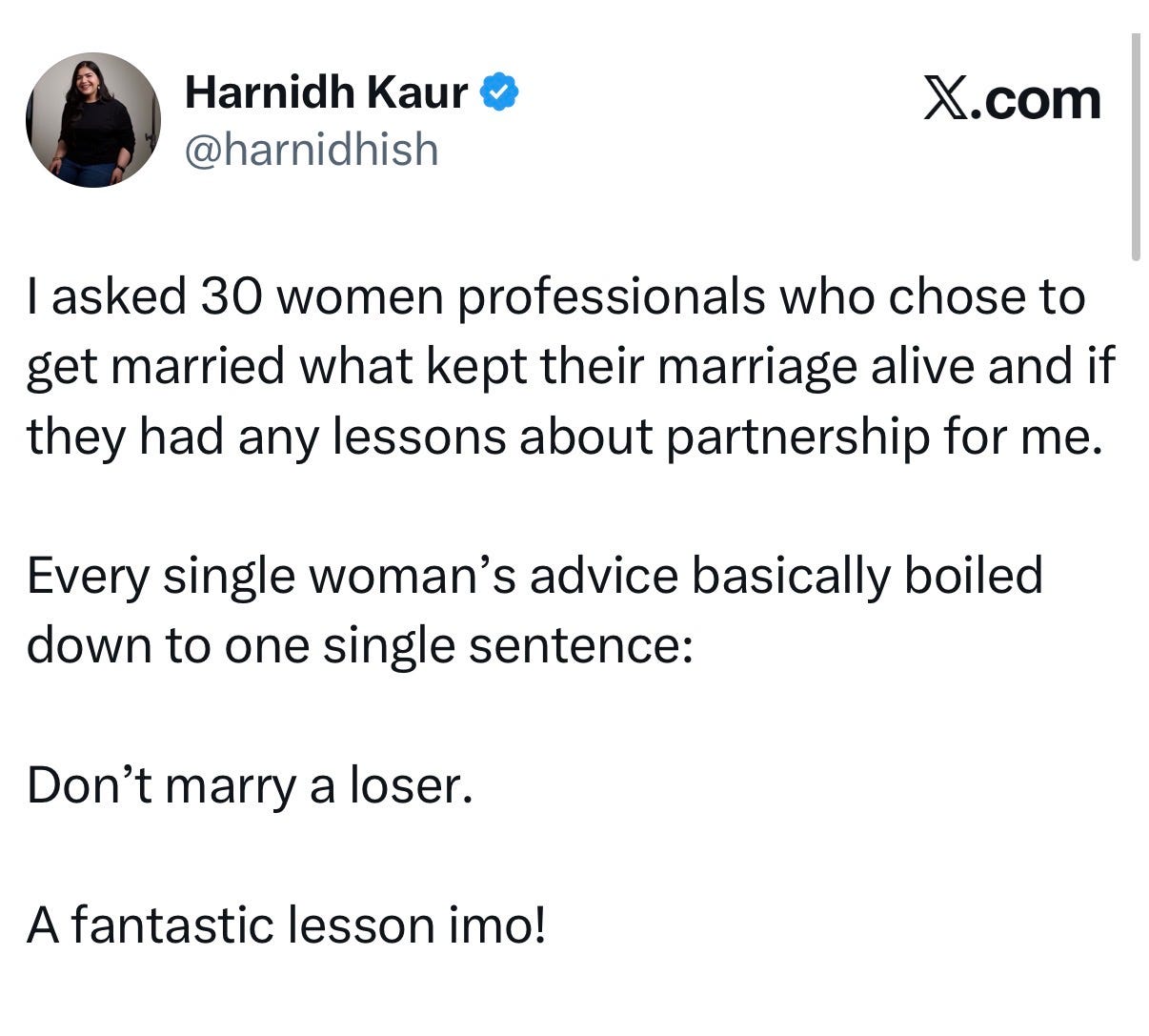
The men lost their minds.


I posted the finding before I’d defined what a loser was. The definition was supposed to be this essay and essays take time. And before I got to the definition, men were in my mentions calling me a loser. Telling me I was bitter and alone. Explaining, at some length, that they were not losers. Asking who I thought I was.



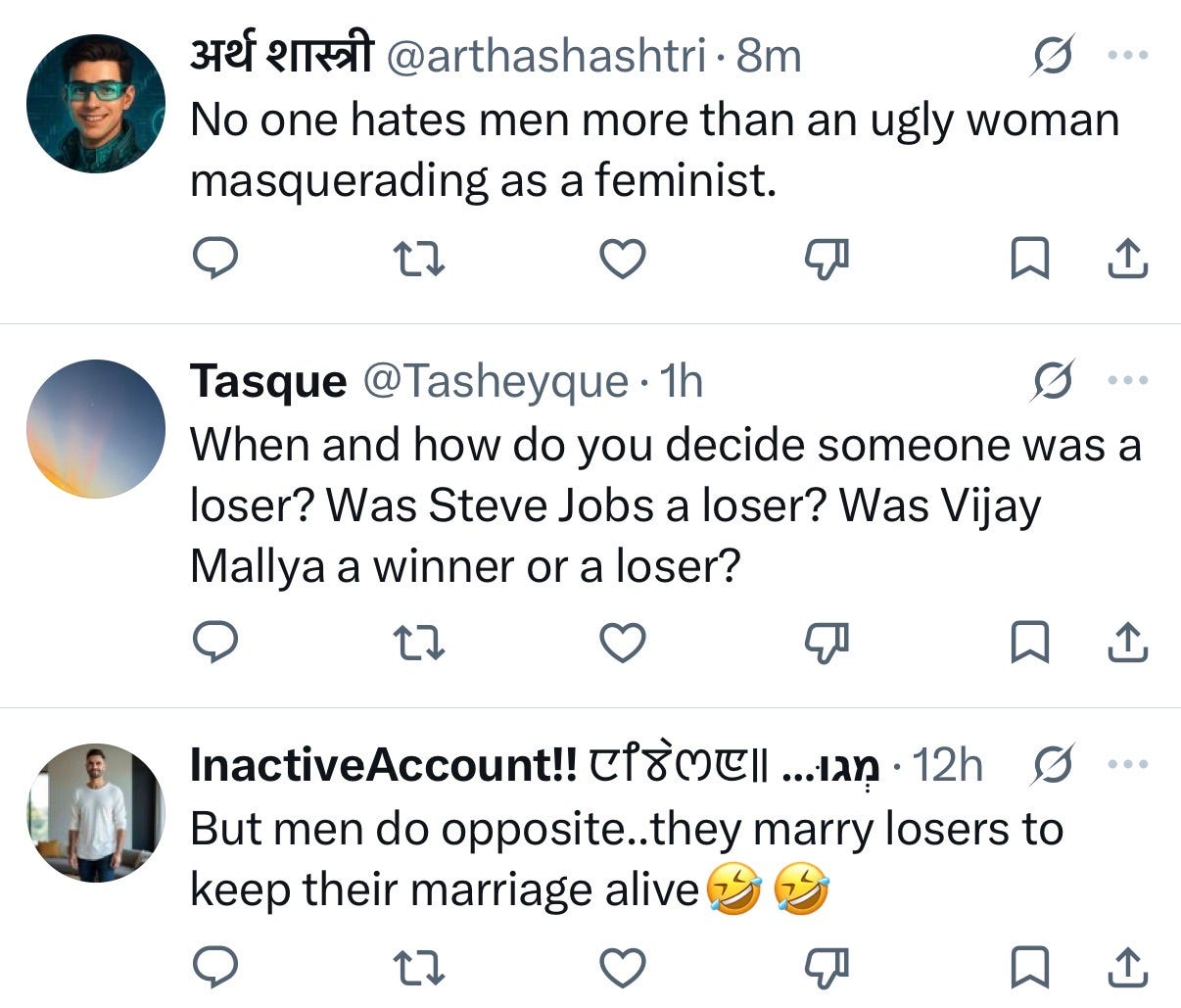

I honestly found it genuinely interesting. Not upsetting, because men have said waaaay worse to me, but just interesting. I had posted a word. No context. No criteria. No list of offending behaviours. No call outs. No metrics. Just the word “loser,” attached to the advice not to marry one. And a substantial number of men had looked at that word, decided it applied to them, and reacted accordingly.
There is a whole body of research that explains exactly why this happens (of course there is). Psychologists Joseph Vandello and Jennifer Bosson have spent the better part of two decades studying what they call precarious manhood, the idea that male status, unlike female status, is treated as something that must be continually earned and can be revoked. Womanhood is viewed as relatively stable and biological; manhood is a performance with no guaranteed tenure. In studies across 62 nations, Bosson et al. found this belief is effectively universal, varying in intensity but not in direction. The consequence is that men with precarious self-concepts become hypervigilant for anything that could threaten their status, and when threat is perceived, they respond with either aggression or withdrawal, depending on how their masculinity norms were originally installed.
But the most useful piece of research for understanding my Twitter comments section comes from a different tradition. Roy Baumeister, Laura Smart, and Joseph Boden published a landmark review in 1996 identifying threatened egotism (not low self-esteem, but high and unstable self-esteem) as the primary driver of hostility and aggression. The people most likely to react angrily to perceived criticism are not people who feel bad about themselves. They’re people whose self-image is favourable but precarious, and who respond to any potential downward revision with pre-emptive defence. The threat doesn’t even have to be directed at them. The mere existence of a category that could apply is sufficient to activate the alarm.
So when men read “don’t marry a loser” before I had defined what a loser was, the ones who reacted with hostility were not reacting to the content. They were reacting to recognition. Something in the word had already triggered a provocation before any evidence had been presented. The research predicts this to the tee: identity-protective cognition, as legal scholar Dan Kahan has extensively documented, means people don’t evaluate threatening information to find truth. They evaluate it to survive the threat to their self-image. The reasoning comes after the feeling of exposure, and it is almost always in service of dismissal.
I genuinely do not think most of these men were bad people. I think they were scared of a word that seemed to know something about them. And that, it turns out, is extremely useful information about who they are in a relationship.
Back to the research, because the data on what a bad partner actually costs a woman is stark enough that I think it warrants its own section before we get to the composite portrait.
Sociologist Allison Daminger’s 2019 study, published in the American Sociological Review, broke down what she calls cognitive household labour into four stages: anticipating what needs doing, identifying options, making decisions, and monitoring outcomes. She found women doing more cognitive labour in 26 of 32 heterosexual couples studied, and that men participated roughly equally only in the decision-making stage, the most visible component, while women dominated the anticipating and monitoring, the invisible preparatory work that happens continuously in the background. Her follow-up research puts the cognitive labour split in heterosexual couples at approximately 80/20. Among queer couples, that gap narrows to roughly 60/40 and doesn’t divide along gendered lines at all, which tells you something important: this isn’t about personality types or natural aptitude. It’s about who was trained by their environment to perceive the cue that a thing needs doing.
Even in genuinely egalitarian marriages, Pew’s 2023 data shows wives spending more than double the hours on housework and caregiving that husbands do, while husbands spend roughly three additional hours per week on leisure.
And then a child arrives, and everything accelerates. Yavorsky, Kamp Dush, and Schoppe-Sullivan tracked dual-earner couples through the transition to parenthood using time diaries rather than self-report surveys (which matters, because when you ask men how much housework they do, they consistently report something closer to 50-50.) The time diaries told a different story. Before the baby, men and women contributed roughly equal unpaid hours. After the baby, women added more than two extra hours of work per day. Men added forty minutes. The perception gap is remarkable. Both men and women believed their contributions had increased equally, which is why you cannot trust a man’s self-assessment of how much he does around the house. He is not lying to you. He genuinely doesn’t know.
The career cost of the wrong partner has been quantified too. Danish economists Henrik Kleven and colleagues tracked earnings trajectories across parenthood and found that women’s employment falls by roughly 25% and earnings by about 33% relative to men’s after their first child, a gap that persists for over two decades. Men’s and women’s earnings track nearly identically before children and diverge sharply after. Sociologist Michelle Budig put a number on the maternal wage penalty: women lose approximately 4% in wages per child, while men receive a pay increase of roughly 6% per child. Mothers are less likely to get called back for jobs, are rated as less competent, and receive wage offers thousands of dollars lower than childless women. Fathers are called back more often than childless men.
This is the stakes of the decision. Not whether he’s nice, not whether he loves you, not whether the relationship feels good right now, not whether your friends think he’s a good guy, not whether he gives you the tingles. Who you choose will determine how much time you have, how much energy you have, whether your career stays yours, whether the ambition you arrived with is still intact a decade from now, or whether it has silently contracted to fit inside someone else’s comfort level.
Okay. Now I can define what a loser is. Because the women I spoke to were very clear that it wasn’t what most people picture.
The loser is not usually the obviously bad option. If he were obvious, women wouldn’t choose him. The loser is recognisable only in retrospect, or to people who know what they’re looking at, or to the friend who’s been with a loser, or to a psychologist (I guess?!) or to the woman who’s spent five years trying to figure out why she feels so exhausted all the time despite nothing specifically being wrong.
The composite definition, assembled from thirty women who have loved it, lived it, left it, or narrowly escaped it, is this: a loser is a man who thinks of marriage as something he is being given rather than something he is building. A man who believes the baseline is that you take care of him, and anything extra he does is a bonus worth remarking upon. A man whose career is a priority and yours is a lifestyle choice. A man who takes pride in what you accomplish but feels no responsibility for what you carry.
He’s not a monster. He often loves you, in the way people love a great vacuum cleaner, in that it make their lives easier. But there’s a particular mode of thinking he cannot exit, one in which he is the protagonist and you are the support infrastructure, and if you try to renegotiate that arrangement, the relationship starts to feel, to him, like it’s being threatened.
A loser is the man who “helps” with the housework, and the verb is the tell. Helps, as if it were your project and he were a generous volunteer. A loser is the man who needs to be asked, every time, because asking is apparently not a skill he has identified a reason to develop. A loser is the man who says he’ll “babysit” his own children when you leave the house, because the language of babysitting assumes childcare is your default responsibility and his is an act of temporary coverage.
In the Indian middle-class context, you are not just choosing a person. You are choosing a family, a set of expectations, and, most critically, a man’s willingness to protect you from the parts of those expectations that aren’t yours to carry. A loser in this context is not just the man who won’t share the housework. He’s the man who is privately supportive but publicly spineless. Who will help you cook dinner for twelve people but won’t tell his mother that hiring a cook is a reasonable thing to do. Who will have an apologetic smile on his face when he throws you under the bus for an obscene familial request and then say something like ‘Yaar, mummy papa hai na.’ Who calls himself progressive but expects you to perform the bahu role on festival days, family visits, and every occasion where his family is watching.
What a good partner does (and I have seen this, it exists) is establish the terms early. He makes clear to his family, before it ever becomes a point of conflict, that his partner’s participation in their customs is her choice and not their entitlement. He doesn’t ask her to call his parents mom and dad. He lets her build her own equation with them, on her own terms. He treats her as his partner, not as someone who has stepped into a predefined role that his family designed before she arrived. That’s not a high bar. But it is one that a surprising number of men cannot clear, because clearing it requires them to occasionally disappoint the people they grew up trying to please, and that, for a certain kind of man, is simply not on the table.
Here is the manifestation of loser that took me longest to understand, because it looks most like love when you’re inside it: the gentle resentment of your success. He’d never say he’s threatened. He’d be horrified at the suggestion. He would probably tell you (and believe himself while saying it) that he’s your biggest supporter. But watch what happens when you’re the one being celebrated. When you get the promotion, the visibility, the recognition, the raise, the LinkedIn kudos, the crappy corporate gift bag. Watch how his energy shifts shape. Watch whether the jokes he makes about your success don’t quite land as jokes, because they aren’t really jokes, are they?
Several women described the same arc: the relationship was good when they were equally matched or when she was slightly behind. It began to corrode when she pulled ahead. A thousand small withdrawals accumulated into a wall she couldn’t see clearly until she was already on the wrong side of it. A 2021 study by Lamarche, Atkinson, and Croft found that men who received low “masculinity scores” in an experimental setting reported less commitment to their romantic relationships. They compensated for feeling inadequate by espousing less interdependence. The resentment and withdrawal aren’t intentional. They are, in the vocabulary of precarious manhood theory, threat responses. This obviously doesn’t make them less damaging. It just explains why you can’t argue your way out of them.
The divorced women told me the hardest part.
You cannot un-loser a man. A loser is a loser until he decides not to be one. You cannot love him into transformation. You cannot patience him into a better version of himself. You cannot out-communicate or out-therapise or out-endure him into change. The women who believed they could (and some of them believed it with tremendous conviction and real love) didn’t fix him. They spent their best years trying, and came out with less of themselves than they’d brought in.
One friend said “I married him thinking he had potential. And I spent seven years confusing potential with promise. Potential is what he could be. Promise is what he’s committed to becoming. Those are not the same thing. You cannot build a life on potential.”
The ones who are genuinely happy (and there are some, more than I expected!) did not luck out. The framing of marital happiness as luck is one of the more damaging stories we tell women. The happy ones chose carefully. They paid attention to data points most people dismiss as too small to matter: how he talked about his exes, how he handled it when things didn’t go his way, how his energy changed when she succeeded, whether he could apologise without the apology becoming a second argument about her behaviour. They trusted their instincts even when the instincts were inconvenient, even when inconvenience arrived after three years of investment. They made a decision with their eyes open, and now they’re reaping the returns on a good early call.
The ones who are divorced all said some version of the same thing too: I knew. Somewhere under all the reasons I had for staying, I knew. There were signs I saw and talked myself out of because I loved him, or because I’d already been with him for years and the sunk cost felt real, or because everyone around me was getting married and I didn’t want to be left behind, or because log kya kahenge? (classic). All of those reasons felt, in the moment, like enough. None of them were.
The research on masculine defensiveness isn’t just an explanation for my X comments section. It’s also a portrait of something genuinely sad. A 2019 study found that men who hold traditional gender ideology and find themselves economically dependent on their partners carry significantly higher physiological stress markers. The body measures the cost of an identity that can’t accommodate reality. A man whose self-worth is so tightly tied to a particular performance of masculinity that any deviation from it registers as existential threat is not, on any available evidence, a man who is having a good time. The loser I described, the man who withdraws when you’re celebrated, who resentfully monitors the gap between your success and his, who needs to be the protagonist in a story that’s increasingly about you, the one who’s a bit of an oblivious numpty, is not a happy person. He is a person whose self-concept is so fragile that it cannot coexist with your thriving.
That is worth knowing. He isn’t doing it to you. He’s doing it to himself, and you happen to be in the way.
So here is the composite advice from thirty women, assembled across thirty separate conversations:
The quality of your marriage will be determined almost entirely by who you choose. Not by how hard you work at it, not by the depth of your love, not by the sophistication of your communication frameworks, not by borrowed lessons, not by hoping for miracles. By who he was when you chose him and who he is willing to keep becoming. Everything else is maintenance on that original decision, and no amount of maintenance can repair a foundation that was wrong from the start. The research across decades, methodologies, and twelve different countries confirms exactly this: the partner variable is structural, not situational.
I’m still thinking about marriage. Still, if I’m being honest, a little scared of it. But this advice has changed how I understand the decision. I used to believe a good marriage was something you built together from whatever you had. I now believe a good marriage is something you protect together, but only if you chose each other well in the first place.
Don’t marry a loser. Everything else follows from that.
Eye-opening! I’d love to look at the individual data and advice from these women. How do you spot a loser early on?
Interesting article. However, loser, when referred to in the context of the male gender, has a meaning beyond how you have defined it. The loser also means good for nothing, and that has a certain connotation attached to it, and many of the Twitter responses are triggered by it. It does reveal male insecurity, as you have pointed out, and the performance of manhood, but more in reference to not being able to conform to the ascribed role of provider, which is more like a cross than a blessing. Also important to acknowledge that once men can provide, they justify refusing the emotional labor required in making a marriage work.