


I wear a fake Van Cleef on my neck.
Well, fake is a stretch. It’s an Alhambra motif on a chain in mother-of-pearl, natural diamond, and 18k gold. It cost me (after a friends-and-family discount) about INR 35,000 (~$370 USD). For context, something identical on the Van Cleef website retails from anywhere between $3,700 to $4,500 USD. I bought it from a lovely lady who sells these ‘real fakes’ to a lot of South Bombay gentry who refuse to pay ‘that much’ for ‘this much’ gold.
In Jamnagar, Nita Ambani turned up to her son’s wedding in what the jewellery influencer and gemstone-monger Julia Hackman Chafé memorably measured as ‘roughly a thousand kilos of emeralds’. There was a necklace built around two yellow diamonds, one of them close to a hundred carats, which reportedly took a thousand hours of workmanship. There was a 52-carat Golconda ring. Her daughter, Isha Ambani, wore a navratna necklace that took three years to make. The groom himself was pinned with a 720-carat panther-on-emerald brooch and a few Lorraine Schwartz pieces for good measure. Every single thing on every single body was commissioned from Viren Bhagat, from Kantilal Chhotalal, from a handful of private ateliers, with a couple of Western houses rounding out the bill. Place Vendôme would not have been able to sell any of this because there is no one to sell from.
Most jewellery in India revolves around the ‘melt price’. Fundamentally, what jewellery is worth is the exact amount you’d get if you pried out the stones, melted the piece, and sold it by weight tomorrow. Run a test for me here- ask your mom. She probably knows the melt price of her wedding jewellery to the gram. She’ll mention something in the lines of ‘The making charges were x%, so we have to remove that, of course’. The design is completely secondary to her in absolute terms. She loves it, of course, but when she talks about giving that jewellery to you when you get married, she’s not talking about the design. She’s talking about the gold.
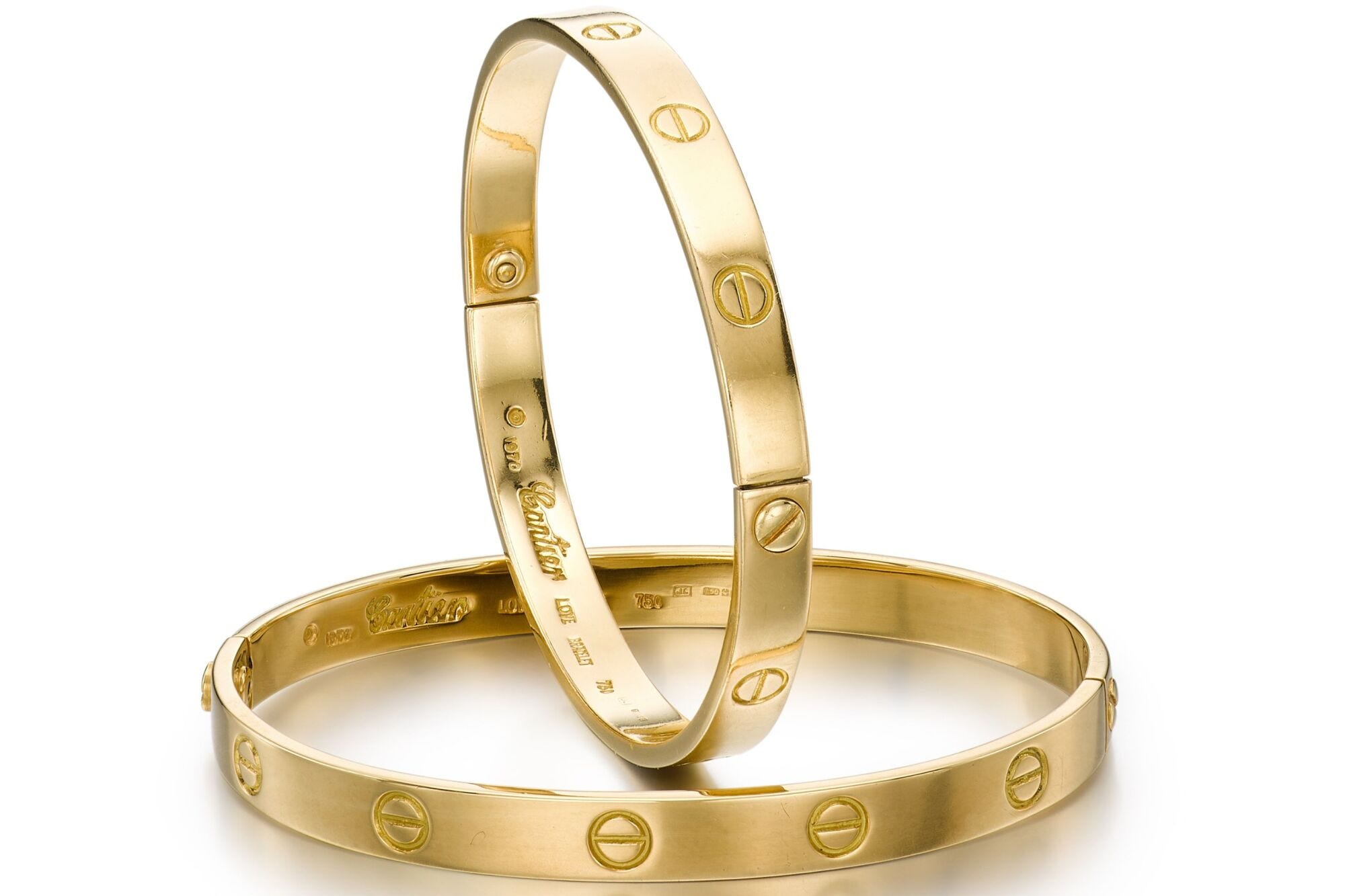
A jewellery brand, on the other hand, would be the exact inverse of a melt price mentality. A brand would essentially be a premium that would far exceed the meltdown value. A Cartier Love bracelet is anywhere between 30 to 38gm in weight and is crafted in 18K gold, which makes about 75% of the total weight ‘meltable.’ The price of 26g gold? INR 3,66,912 (USD 3890). The price of a Locve bracelet? INR 6,20,000 (USD 6574) to over INR 8,00,000 (USD 8483) for plain models in India, while diamond-paved versions and special edition styles reach INR 38,00,000 (~USD 40,000). You wouldn’t even think of melting one if these. The entire foundation of western luxury jewellery (and I’m not talking about high jewellery, just luxury jewellery) across the last two centuries has been to imbibe meaning into material, and then price that meaning as an asset.
India does not work like that. Our brand recall is not tied to meaning. It’s tied to melt price. Tanishq is not a brand because Tanishq jewellery is immediately recognizable. It’s because Tanishq jewellery is made of Tanishq gold. We do not optimise for brand, unless the brand is proxy for trust.
My argument is simple. India never built a Cartier because Indian jewellery evolved as a savings instrument rather than a symbolic luxury good, and because the institutions that manufacture global prestige remain overwhelmingly European.
This essay is about why. It will take you from Jaipur to the Place Vendôme, from the Koh-i-Noor’s recutting to Nirav Modi’s prison cell, from kundan and meenakari to the Kering balance sheet, from a Tata-owned cash machine to a man in Mumbai who makes seventy pieces a year and is one of the best jewellers alive. I’ll tell you who got robbed, who robbed themselves, who’s actually cracking it right now, and why the question of where is the Indian Cartier? is not about India or Cartier at all.
The case for the prosecution
One way of looking at this (which honestly, I don’t think is the wrong way of looking) is to see India as the seam that was mined, and who can blame the plundered for not caring about branding?
When the British stole the Koh-i-Noor in 1849, they sent it to the Crown Jewellers in London. They put it on display at the Great Exhibition of 1851 as a trophy, proclaimed it too uncivilised for European tastes and had it recut from 186 carats to 109. Swap opium for diamonds and you have a parable about colonial extraction right there.
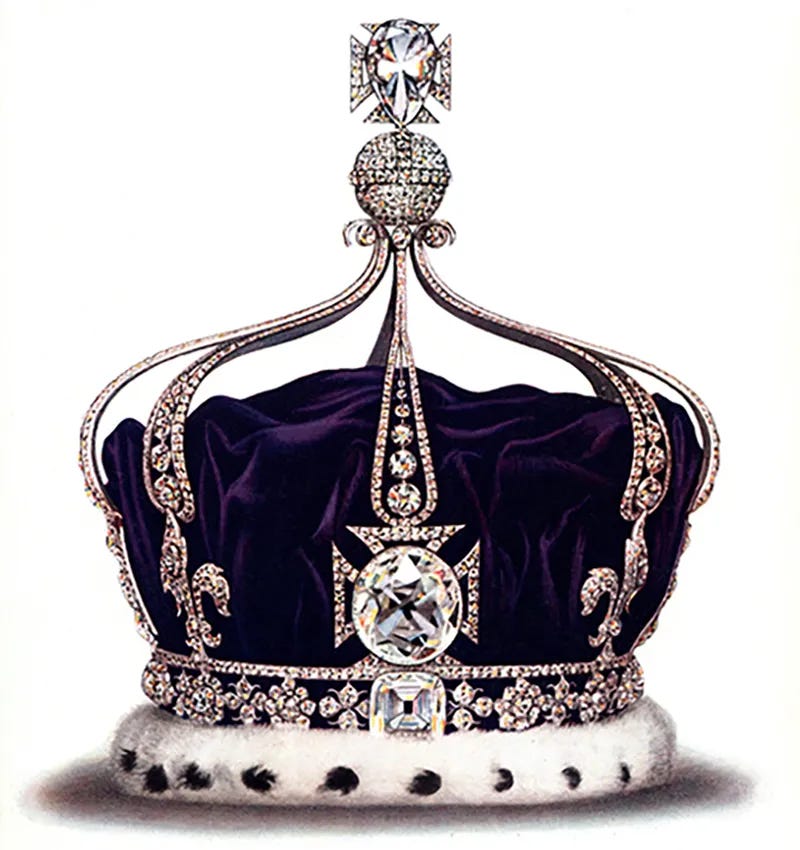
Indian stones, Indian commissions, Indian inspirations fuelled the collections of the Place Vendôme set (aka Cartier, Boucheron, Van Cleef, Chaumet, Mauboussin) throughout the 1920s and ’30s, the maharajas acting as both muse and customer. You walked into Cartier with your family tiara and left with an Art Deco resetting of it. Value-add (design, brand, margins, mythology) happened in Paris. India provided the material and, increasingly, faceless artisan labour.
Not much has changed since. Today, Surat cuts and polishes 90% of the world’s diamonds by volume. Every jewellery big-shot you can think of has Indian labour at their artisan table. Literally, we are running the world’s glitter back office.
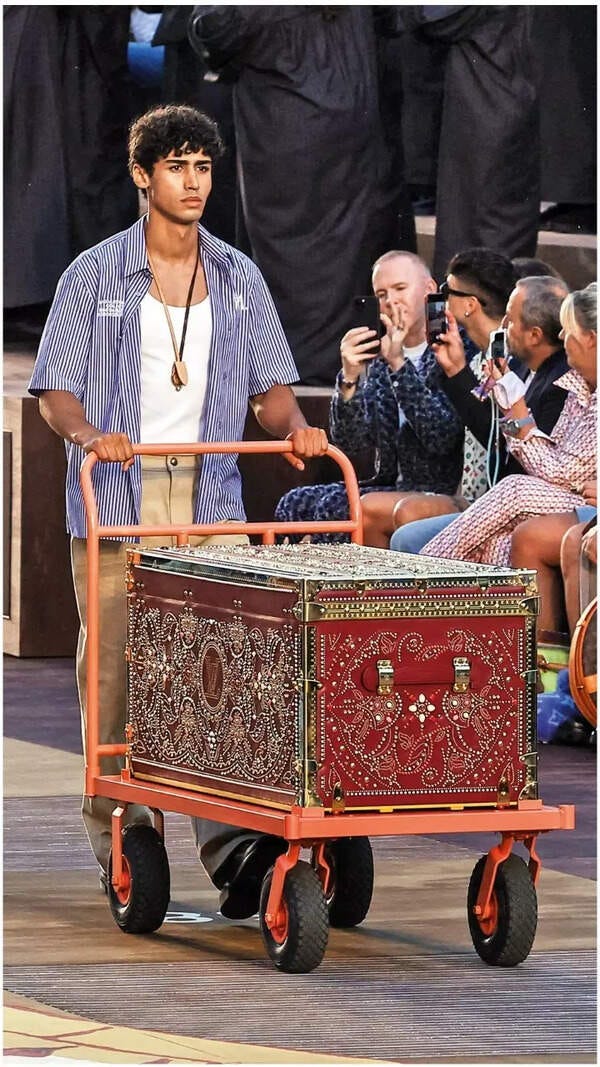
When Pharrell Williams took creative charge of Louis Vuitton menswear last year and put on a Maharaja-themed show at the Pompidou in June of 2025, climaxing it with a model rolling down the stairs in jewel-crusted khakhi shorts as A.R. Rahman’s Eden relentlessly pumped, it was undeniably beautiful. It was also India getting brand laundered through French retail with the IP and profit accruing to…LVMH.
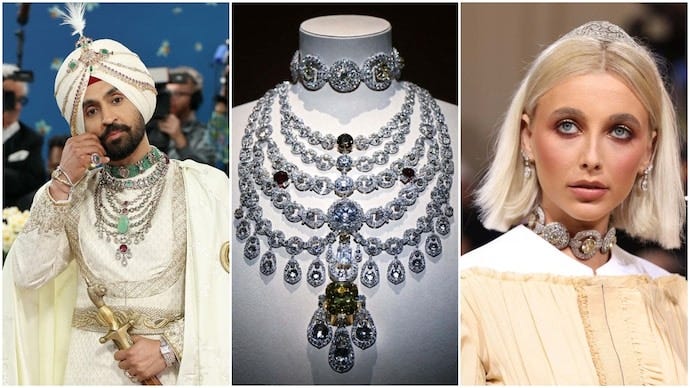
Cartier loaned Emma Chamberlain, a 20-something white American YouTube celebrity who, as far as I know, has no ties to India whatsoever, one of their most famous diamonds (a Maharaja of Patiala-linked necklace) to wear while they uploaded her marching up the steps of the Met in Feb ’22. Come March 2025, Diljit Dosanjh, one of the biggest Punjabi stars in the world, son of a Punjab Roadways clerk who — wait for it — built his homage of a Met Gala outfit around a love letter to Maharaja Bhupinder Singh, directly messaged Cartier asking to borrow the real thing. Cartier politely let him know it was unavailable (through his stylist).
He wore a replica instead and said afterward that the necklace was theirs and that Cartier had taken it. In fairness to the house, the piece was a centerpiece of Cartier’s own exhibition at the V&A in London that very year, so it was committed elsewhere. But it’s hard not to feel a little iffy, yeah?
You could stop reading this essay here, and it would be enough, honestly. We can agree that India didn’t fail to make a Cartier. India was what made Cartier. Not incorrect.
Take TBZ. Tribhovandas Bhimji Zaveri started in 1864, which makes it older than Bulgari, older than Van Cleef, almost as old as Cartier. So “we didn’t have time” was never the excuse; it’s had a hundred and sixty years. And today it’s a gold retailer. A big one, a listed one, dozens of showrooms, but you still walk in, they weigh the piece, quote you a making charge, and you carry it home priced by the gram. The British were gone for most of those hundred and sixty years. We had all that time to ourselves and we spent it selling gold.
A prospective diagnosis
The gold problem
Indians buy more gold than anyone else in the world. We bought 564 tonnes in 2024 but we overwhelmingly buy it as a savings instrument. Gold is probably the mosy trusted asset in India, and jewellery is its most socially (and physically) mobile form. When an Indian buys jewellery, the resale calculation occurs in tandem. The making charge (usually 5-30%) is not what you pay for the design, the labour, the craftsmanship or the brand. It’s a loss you suck up and tolerate.
You cannot build a brand premium when your customer barely tolerates a brand premium. Melt value places a ceiling on myth value. Richemont’s chairman, Johann Rupert, talks openly about competing with the vast ‘non-branded’ end of the jewellery market in the western world, and this dude owns Cartier and Van Cleef.
The fragmentation problem
The supply side of the jewellery industry is barely an industry. Over 90% of Indian jewellers are family owned. According to World Gold Council, only 15-20% of manufacturing is organized and large-scale (and that’s up from 10% a few years ago!) Our entire jewellery sector, dispute its awesome scale, draws a honestly pathetic 2.7% of India’s offered credit. Speaking of retail, your friendly neighborhood ‘family jeweller’ is running on cash, gold-loan dent, and underreported turnovers. He also makes up about ~70% of the market, with organized retail struggling to even cover 20%.
Fundamentally, this means that there has never been an Indian LVMH. No one has been able to roll up the great family houses, professionalize their businesses, hand them archiving abilities, magnify their advertising budgets and museum partnerships, get them a splashy store on Bond Street, and globalize them with generous, specialized and most importantly, patient capital. When you and I as consumers see a Big Old Brand, we don’t see the infrastructure that’s propelling them ahead. Conglomerates like LVMH, Richemont, Kering and more have spent decades and effectively infinite money turning ateliers into brands, and brands into statements. This is not a testament to the power of craft, it’s one to capital.
The karigar problem
The craft and expertise that forms the load bearing piece of this conversation is performed by people who earn, by NITI Aayog’s 2020 estimate, in the vicinity of INR 15-16,000 (~ USD 150). More than 70% of tehm have no social security or savings, and a meaningful share of them have children who are bonded labourers in workshops across West Bengal and Mumbai. Over half of all Indian jewellery is still made by hands, and those hands rarely see even a fraction of the price they command.
Beyond the morality of this devastation (which is devastating, of course), it’s a brand problem. One of a brand’s greatest abilities is to make a maker famous. Think Cipullo for Cartier, or Schlumberger and Peretti for Tiffany. The brands elevated individuals to recognised signatures they could change a premium for. Western luxury houses understand that the author is the asset. The entire jewellery economy of India, however, is built on the anonymization of the author. The maker here is a cost line, deliberated invisibilzed and fungible. You cannot build an auteur brand without said auteur, can you?
The distribution problem
The last part of this diagnosis is simply access. There are rooms where prestige is minted (and I’m not debating the fairness of this, I know it’s unfair). It’s the Place Vendôme addresses, the Bond Street and Madison Avenue flagships, the Geneva auctions, the connoisseur circuit, the museum loans, the auction-house provenance that turns an object into an investment. A piece of jewellery in a Jaipur vault and an identical one in a Sotheby’s catalogue are, as financial instruments, strangers to each other. Despite our storied and archived legacy, we have been unable to build intrigue around the speculative value of our craft.
Heirloom versus logo
Firstly, what IS a Cartier Love bracelet? Literally it’s just a screw motif from 1969 that you can slap on a bracelet, ring, necklace, pair of earrings, keychain, cake, cookie, scarf, ad infinitum, in countless “stories” but one that’s infinitely familiar as belonging to that brand, and by extension, its history. The Alhambra is a clover from 1968 that remains valuable today because it’s a repeatable logo with artificially restricted supply. The Serpenti is simply a snake you can coil around anything you like. Lock in one narrativized, protected, productized motif and you have eliminated the need for a thousand craftsmen, and can scale across a hundred stores like a franchise.
Indian high jewellery works from the exact opposite premise. Within the Indian system the stone leads. It has astrological and talismanic significance, trumping any brand signature. The settings are bespoke commissions, or else dynastic objects passed down and remade over generations rather than reordered from a menu. Craft itself gets subdivided by regional speciality. You buy the meenakari enamelling of Jaipur, or temple jewellery of the South, Mughlai kundan-setting, the thewa work of Pratapgarh, Bidri from the Deccan, filigree from Cuttack. Each is controlled by a guild and dedicated to maintaining a tradition. None of them are trademarked.
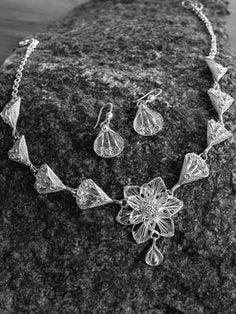
But if they can’t be trademarked, what can you? Again: story. Which opens a genuinely radical possibility: the absence of a recognizably Indian hallmarks stems not from weakness but from a profound difference in how Indian jewellery relates to craft, and to gold itself.
The ghost: the man who tried, and why he’s in a London cell
Nirav Modi. He launched in 2010 with grand, explicitly stated plans to be the first global Indian luxury diamond brand. He aimed high. To be the Indian Harry Winston. And boy did he ever run the playbook by the book. Boutique on Madison Avenue. Worship space on Old Bond Street. Hong Kong. Proprietary “Jasmine” cut to serve as his signature. Kate Winslet photographed in his diamonds at the Oscars, Priyanka Chopra rolling through his carpet. Storied craftsmanship made at such volume that it left the old guard gasping at his speed. He was, for a while, the physical incarnation of the answer to all the questions this essay asks.
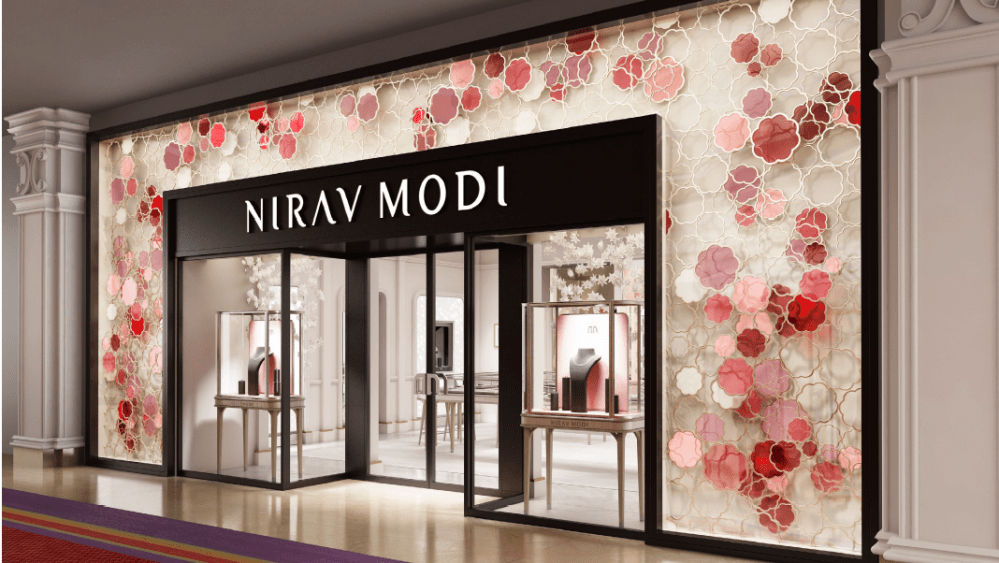
Except then in 2018, it all came crashing down. Turns out the entire glittering empire was sitting on approximately INR 14,350 crore (USD 2B) borrowed from Pubjab National Bank under the auspices of fraudulent letters of undertaking. Modi skipped the country and is now sitting in a London jail cell.
Nirav Modi is epitome of what you get when you try and buy narrative capital with capital. You can’t leverage myth value because the thing you’re trying to purchase doesn’t actually exist. Modi tried to take it all in one go, and it gave him a zero balance. It doesn’t matter how you dress the gold up. One day, you have to open that safe and spend it.
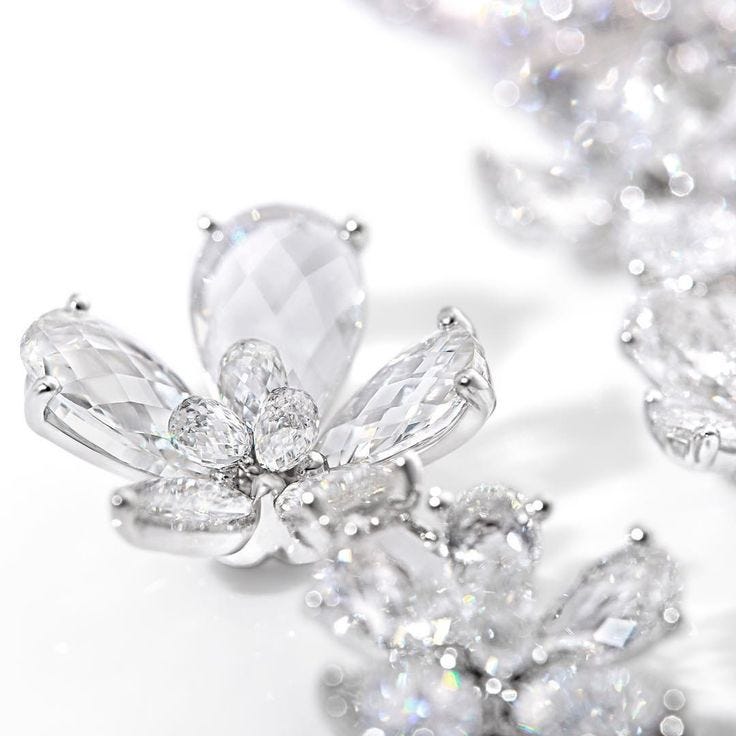
Modi isn’t the only one either. You name the brand, there’s probably some Maharaja lurking behind the scenes somewhere. The error may change shape but at the heart of each of these failures is the same problem. They all bought proximity to a brand name, when what they really should’ve been doing was building a brand people would pay money to be near.
Mapping the contenders: who’s holding which piece of the puzzle
So is anyone actually doing it right? Sort of. Every single ingredient a global Indian house would need already exists in India right now. It’s just that no one person is holding more than one of them at a time.
Viren Bhagat has the hand
Bhagat is the closest thing India has to a Schlumberger. Creating out of Mumbai since 1991, he makes perhaps sixty to seventy unique pieces a year. The platinum settings he has created make the stones look like they’re floating, and have been described as “European in its engineering and unmistakably Mughal in its soul”. You will never find a Bhagat at a store (how gauche). His own store, opened in 2025, is by invitation only. He sells almost exclusively through Christie’s and Sotheby’s and intimate private viewings (I have been dying to go, but I have never been able to get access to them!) His work sits in the Al Thani collection and one of his brooches was actually hammered at USD 212,000 at a Christie’s Maharajahs and Mughal Magnificence sale.
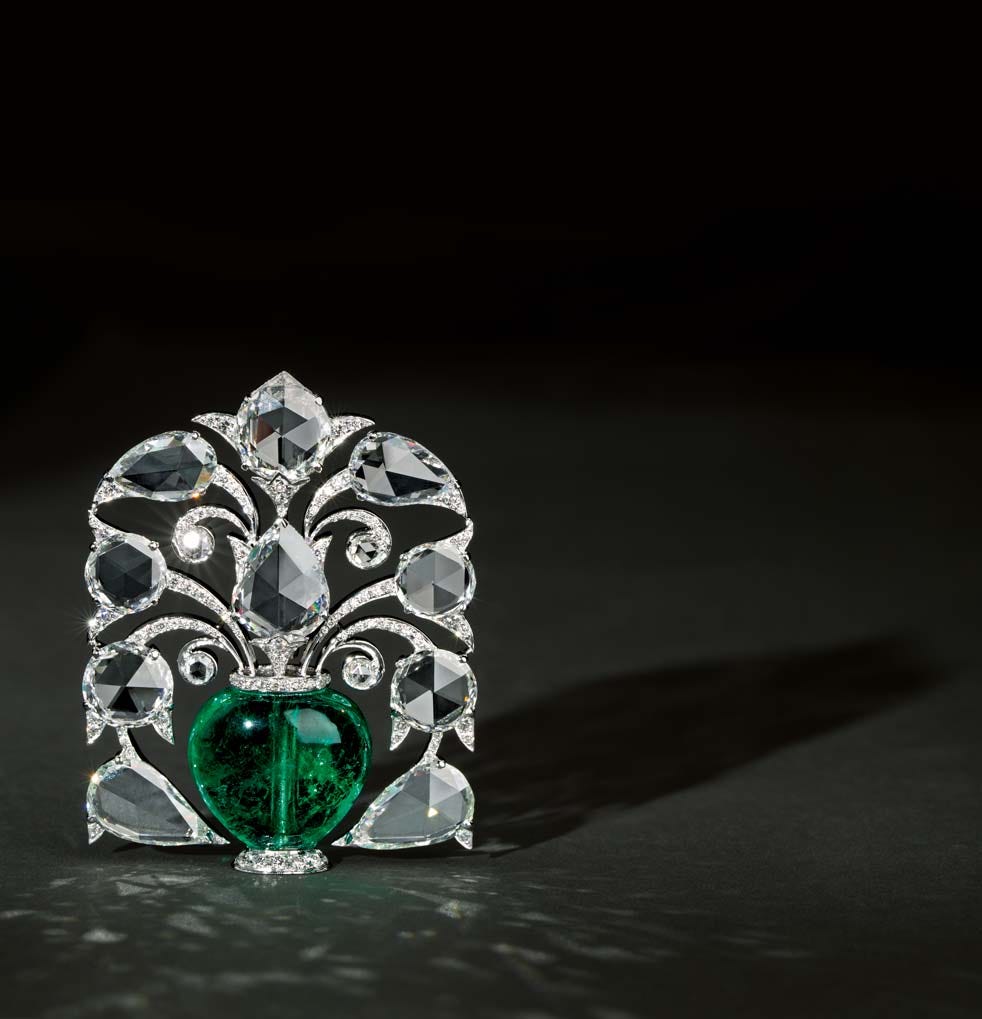
He is also, by deliberate and admirable choice, microscopic. He is, I’d argue, standing proof that India can produce a world-class signature hand. He is also standing proof that one signature hand, however incredible, does not make a Cartier.
Sabyasachi has the story
Sabyasachi Mukherjee has the rarest and arguably hardest ingredient: he understands that the real product is the story. He understands that that you sell a universe people buy into, not a thing they buy. The brand he has created is so totally encompassing that it functions as a worldview.
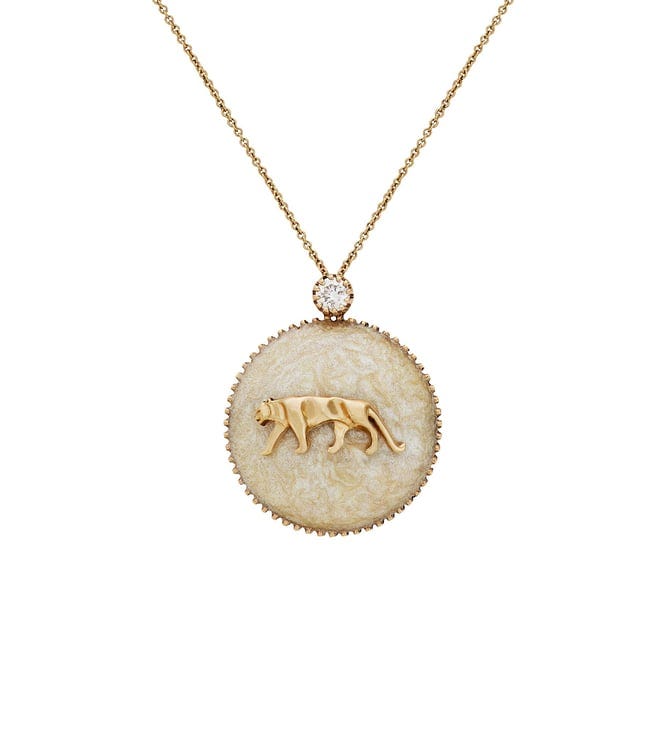
He’s been stocked at Bergdorf Goodman since 2020, opened a New York flagship in 2022, and said that the next generation of the world’s greatest designers will come from India. He has truly managed to build heritage as narrative. I would argue he is the closest to what we are seeking here.
Unfortunately, the risk in fashion house jewellery is that it stays an accessory to the clothes. It’s a line extension rather than a free-standing offering that could survive without the classic Sabyasachi lehenga and a plunging choli neckline.
He is probably the strongest brand builder in this country and is attached to the strongest narrative engine. If anyone bridges craft and mythmaking at scale, it’s probably him.
The Gem Palace / the Kasliwals have the passport
The Kasliwal family were court jewellers in Jaipur from the eighteenth century, under Sawai Jai Singh II, and in the modern era The Gem Palace got into the rooms. The Met (the 2001 “Treasury of the World” show), Somerset House in London (the first Indian jeweller exhibited there), Barneys, a Madison Avenue address. Sabyasachi himself has credited them with mastering the packaging of mystery and intrigue. Unfortunately, they then splintered into a constellation of family ventures rather than consolidating into a single scaled global house. The family outgrew the brand instead of allowing it to scale.
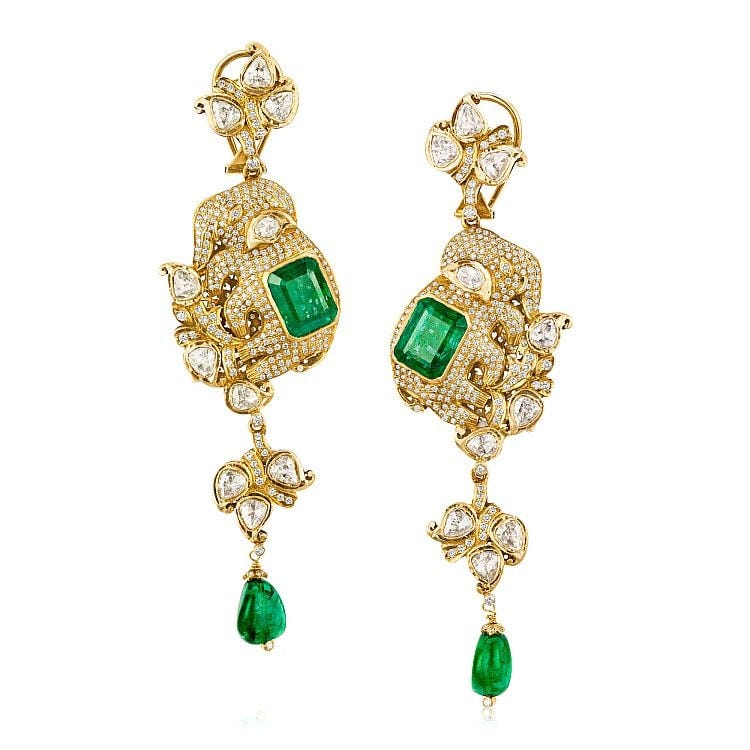
Sunita Shekhawat has the museum
Shekhawat has been working in Jaipur Meenakari since 1996 and she opened the Museum of Meenakari Heritage, which is India’s first private museum dedicated to a single craft curated with a serious jewellery historian. This is the archive and legitimacy play that every european house made on its way up. You build the museum and the museum feeds into the brand. It converts jeweller into a custodian of civilizational narrative
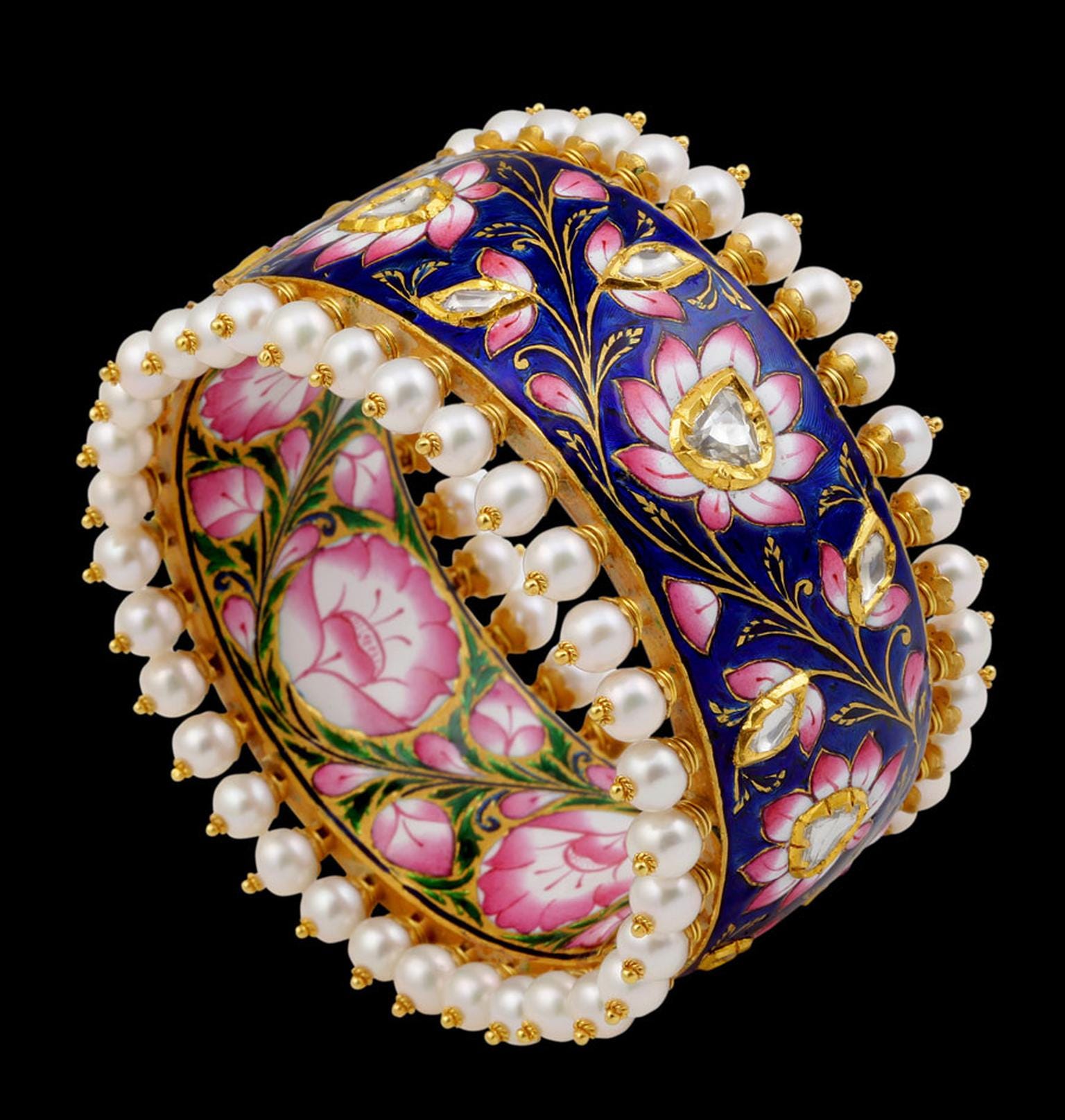
Tanishq (and Zoya) has the balance sheet
Founded in 1994, Tanishq is the Tata answer. Its FY24 revenue was around INR 41,000 crore rupees, roughly an 8% share of the total market. It is the country’s number 1 branded jeweler, and it is on pure business terms the great indian jewellery success story. It has been reaching the luxe shelf with Zoya and D2C with CaratLane. It is the one player that has managed to professionalize the sector and won mass-trust in an unorganized low trust market. It won on purity and hallmarking, which is mass prestige not myth building. It conquered the melt price by being more honest and transparent about it than anyone else. Zoya is a genuine attempt to climb out to the top of the industry by making a name for itself on brand and story. The Tanishq-Zoya story is proof that patient capital and operational excellence both exist in India but are obviously pointed at trust rather than brand building. Whether Tanishq has the appetite to build a global icon as opposed to a superb domestic machine is something that time will tell.
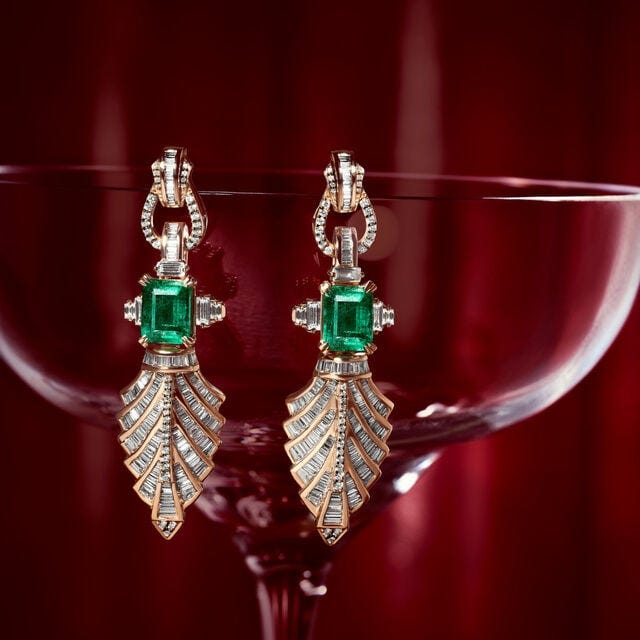
The heritage cohort and the new-luxury cohort have the feel
Heritages houses like Amrapali, Hazoorilal, Birdhichand Ghanshyamdas (which made pieces for the Ambani weddings), and the rest are legitimate craft anchors operating mostly as regional or national players. The new-luxury, contemporary-designer wave, like Hanut Singh with his celebrity and diaspora following, plus the likes of Misho, Outhouse, Apala, Suhani Pittie and others, are distinctive design voices, mostly early-to-mid scale, several of them genuinely interesting on the global contemporary-jewellery circuit.
The disruptors have the wedge
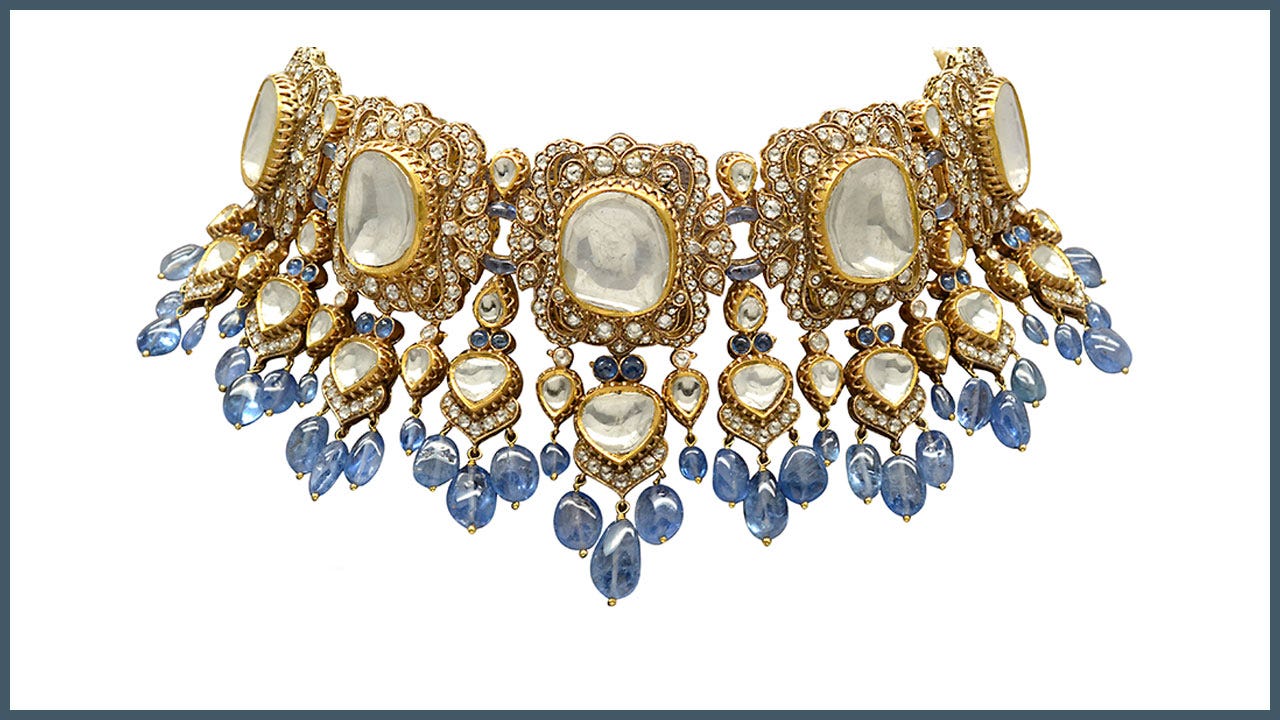
And then the modern challengers. CaratLane (Titan bought out the founder’s stake in 2023 in a deal valuing it near two billion dollars), BlueStone (founded 2011, IPO’d in 2025 at a multi-thousand-crore valuation), and the lab-grown insurgents like GIVA, Aukera, the Dholakia-backed plays. They’re scaling, they’re digital-native, and they’re mostly playing in the affordable and mid tiers domestically, but they’re the ones building the muscle (D2C, design IP, brand storytelling unbundled from gold weight) that the prestige play will eventually require. The infrastructure for an unbundled, design-led, brand-premium Indian jewellery business is being built right now, just one or two price tiers below where the icon will eventually need to stand.
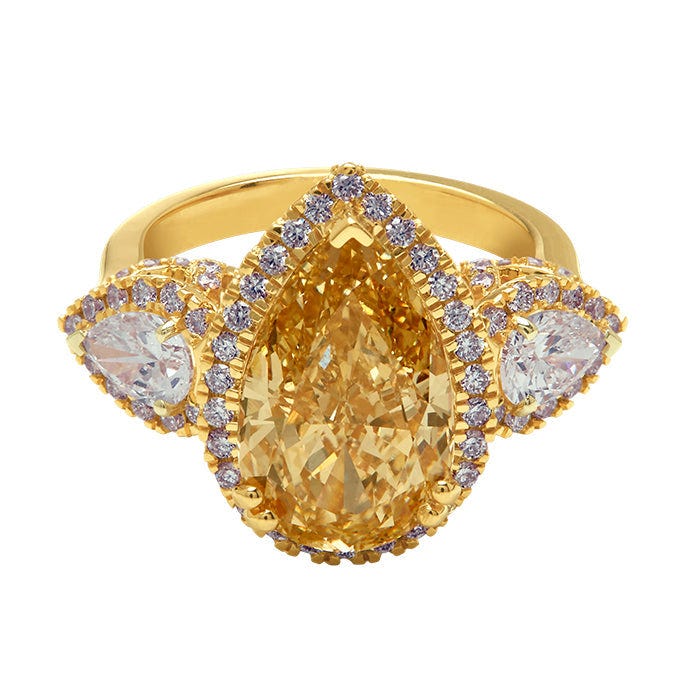
Tally it up and the picture is almost exasperating. Nobody has all six. The Indian Cartier currently exists as six different institutions, in five different cities, in tirty different vaults, and they have have mostly never been introduced to each other.
🎩 Investor hat on 🎩
If a founder were sitting across from me right now, fresh off the boat to pitch me “the first global Indian jewellery house,” this is what I would want to see, and what would make me pass.
Patient money. Myth value doesn’t compound on a 3-5 year timeline. This needs a family office. Or honestly, just some billionaire who wants this thing to exist more than they want the return. Somebody building not for the IPO, but for their own heirs. Every founder who tried and failed to do this on a venture clock over the last twenty years is now, directly or indirectly, either a line extension at a larger brand or an extradition request with Russian attorneys.
I want a name on that door. An actual person. Face. Eyes. Taste you trust. Elsa Peretti’s taste was Tiffany’s product, and whoever comes into this market will need to own the same advantage. Push it even further than one celebrity designer signing her lines. Make the karigars as famous as the boss woman (or boy) London wants to hang posters of. “We make our makers famous” is a moat in this business.
Distribution, but be clear about which kind. Export is export and selling precious shiny things to wealthy Indians (and their infinitely more valuable diaspora!) is absolutely a business, and a good one, but it’s also the definition of a trap because it’s winning at nothing more than India selling itself. The diaspora buys jewellery as an act of love, and love is no use to you if prestige is your goal. The first customer who can look at that logo and want it for reasons that have nothing to do with wanting the thing her parents wanted…Land THAT sale, and congratulations, you have a brand. Sell to the diaspora and watch your business do exponential spikes every December? A fantastic export company.
Can the brand advocate against The Weighing? This is the hard one. You’re asking your customer, a buyer whose entire culture has trained her to price jewellery by the gram over the last couple hundred years, to not do that. Just walk into a store, drop five thousand dollars on something you like, and trust that you won’t be expected to weigh it when you want to sell it? That is re-training an industry’s customer base, and half of them will kill themselves in the middle of your sermon. The other half will get you a hugely defensible moat. You have to survive the middle for long enough to get to the far side.
Then come to me when you’re ready to talk lab-grown. Lab grown is terrorizing the price point of the diamond itself down toward zero-dollars-a-gram, which is great news for signet and terrible news for Surat’s diamond cutters, but hear me out. When the diamond is removed from “where all the value resides” the value has to live somewhere. Guess where it clusters? Things you can’t weigh. Design. Name. Story. Narrative. High margin stuff. Strip the rock out of the equation and everything we thought we knew about jewellery hierarchy starts to unravel. That window is open. Right now. It will not stay open.
The one thing that will make me call you and pass on the spot:
Any founder who opens with “I’m the Cartier of India.” The real Cartier of India won’t say that. She’ll walk into your office with a name you can’t pronounce yet, and ask you to wait.
The real question was never about India
I opened by asking where the Indian Cartier is. By now I’m fairly sure that was the wrong question, or at least a vain and parochial one.
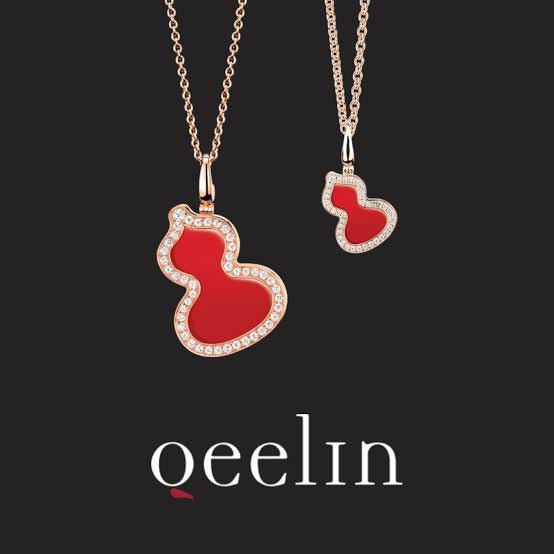
Where, for instance, is the Chinese Cartier? China has more wealth, more manufacturing might and arguably more state ambition than India, and its most internationally styled fine-jewellery brand, Qeelin, is owned by Kering, a French conglomerate that bought it in 2012, back when it had fourteen stores. The buzzy domestic disruptor, Laopu Gold, has gone vertical on the Hong Kong market by branding itself the “Hermès of gold” and posting staggering numbers, and analysts note, accurately, that it has essentially no pricing power beyond the gold itself and little cultural resonance past diaspora pride. And the African Cartier? Africa is where the colour comes from. Zambia’s emeralds, Mozambique’s rubies, the diamonds of Botswana and Namibia and South Africa, the raw material for a century of Western high jewellery. Roughly half the world’s rubies and a quarter of its emeralds now pass through a single miner, Gemfields, which is headquartered in London, sells nothing but the rough stones, and whose own luxury label is Fabergé, a Russian imperial name bolted on because African stones apparently can’t be a brnd unto itself. Even Africa’s biggest gemstone house had to borrow a dead European’s name to move its own rocks.
And the one genuinely African-led high jewellery house, Vania Leles’s Vanleles, which calls itself the first, sits on Bond Street. Where else? The people who dig the stones never make it into the story, and the jewels end up credited to some European maison instead of the ground they came out of. Sound familiar?
There’s only one outlier in the entire world. Mikimoto. A Japanese man grew the world’s first cultured pearl in 1893, opened his first store in Ginza in 1899, and created a truly international luxury brand that survives to this day. But study his approach. A disruption-creating technology that demanded attention. He burnt carts of low-quality pearls on camera, draped a sculpture of the Liberty Bell in pearls for the 1939 New York World’s Fair. He earned Western respectability while European wholesalers petitioned the government to legally recognise cultured pearls as imitation. He courted Western approval until the West crowned him a modern miracle. Non-Western brands can absolutely create global prestige brands and Mikimoto is proof of that, but he had to do it on nearly entirely Western rules
Which, incidentally, is the true lesson behind all of this. “Cultural narrative equity” or the ability to create myth-value, to charge for a logo, to sell your country their own culture back at a profit and have everyone congratulate you on your taste is not an even playing field that anyone can mine however hard they work. It’s an economy. And the economy is owned.
Three European groups own most of the brands. Most of the flagship stores. The auction houses. The museum associations. Most importantly, they own the very language with which we define what luxury is and where it can come from. India didn’t lose at capitalism. India wasn’t allowed to play on the sports team to begin with, and you can’t win at a game where the rules are also the trophy.
The question shouldn’t be how India can’t make its own Cartier. Indians already make Cartiers for a profession; we have, for decades. We made at least three of them last summer, all for one wedding. The question is who gets to put their name on the brand and that isn’t a question of expertise, or of funding, or even, really, of colonialism though it is the result of those things too. It’s about who gets to say something is valuable within a society that has spent its entire existence ensuring that answer only has one answer.
Resources/reading:
Gold price India (24K ~₹14,165–14,553/g; 18K ~₹10,825/g), June 2026 — your ₹3,66,912 melt figure for ~26g checks out: GoodReturns https://www.goodreturns.in/gold-rates/ · ClearTax https://cleartax.in/gold-rate-india · BankBazaar https://www.bankbazaar.com/gold-rate-india.html
USD/INR ≈ 94.3 (June 2026) — all your dollar conversions are correct at this rate: Wise https://wise.com/us/currency-converter/usd-to-inr-rate/history · PoundSterlingLive https://www.poundsterlinglive.com/data/currencies/usd-pairs/USDINR-exchange-rate · BookMyForex https://www.bookmyforex.com/currency-converter/usd-to-inr/forecast/
Cartier Love bracelet (18K, ~30–40g) / Van Cleef Alhambra (~$3,700–4,500 retail) — verify exact retail prices against the brand sites before publishing: cartier.com (India) and vancleefarpels.com. The weight and gold-content math are sound; the retail numbers move, so screenshot them.
Ambani wedding jewels — Nita’s “~1,000 kilos of emeralds” (Julia Hackman Chafé), ~100-ct yellow-diamond necklace, 52-ct Golconda ring, Isha’s 3-year navratna, groom’s 720-ct panther-on-emerald brooch + Lorraine Schwartz — Harper’s Bazaar Arabia (Chafé) https://www.harpersbazaararabia.com/hbanews/ambani-wedding-best-jewellery · (Shekhawat made meenakari boxes for Nita Ambani: Robb Report India https://www.robbreportindia.com/style/bespoke/master-of-meenakari-sunita-shekhawat-reveals-her-first-collectables-range-and-shares-why-jaipur-is-a-crafts-hub )
Cartier 1847 · Tiffany 1837 · Bulgari 1884 · Van Cleef & Arpels 1906 · Harry Winston 1932 — house histories; VCA 1906 (Alfred Van Cleef + Estelle Arpels):

Alhambra (1968) · Love bracelet (1969, Aldo Cipullo) · Serpenti (c.1940s) — brand-documented; cite vancleefarpels.com, cartier.com, bulgari.com archives.
Patiala Necklace (commissioned 1925–28, 2,930 diamonds, ~962 ct, 234-ct De Beers yellow) — Wikipedia https://en.wikipedia.org/wiki/Patiala_Necklace · Al-Thani context https://www.youandi.com/bejewelled-treasures-al-thani-collection/
Golconda diamonds (Koh-i-Noor, Hope, Regent, Orlov, Darya-i-Noor); Koh-i-Noor taken 1849, shown at 1851 Great Exhibition, recut 186 → 105.6 ct — Wikipedia https://en.wikipedia.org/wiki/Koh-i-Noor · World History Encyclopedia https://www.worldhistory.org/Koh-i-Noor/ · Bard/West 86th (the recut as colonial allegory) https://west86th.bgc.bard.edu/articles/romancing-the-stone-victoria-albert-and-the-koh-i-noor-diamond/
Surat cuts/polishes ~90% of the world’s diamonds by volume — Indian School of Gemmology / industry https://www.isgj.org/blog/why-surat-is-the-diamond-capital-of-the-world
Pharrell × Louis Vuitton SS26 (June 24, 2025, Centre Pompidou; Moksha Patam / Snakes & Ladders set by Bijoy Jain / Studio Mumbai; A.R. Rahman “Yaara Punjabi”) — Dazed https://www.dazeddigital.com/fashion/article/68097/1/louis-vuitton-mens-ss26-paris-fashion-week-pfw-pharrell-snakes-and-ladders-india · Hollywood Reporter India https://www.hollywoodreporterindia.com/lifestyle/fashion/inside-pharrells-india-inspired-louis-vuitton-ss26-collection · Design Pataki https://www.designpataki.com/bijoy-jain-ar-rahman-takeover-pharrells-vuitton-vision/
Emma Chamberlain wore a Patiala-lineage Cartier choker at the 2022 Met Gala — The Glitz https://theglitz.media/why-cartier-refused-diljit-dosanjh-the-iconic-patiala-necklace-for-met-gala-2025-but-gave-it-to-emma-chamberlaine-for-met-gala-2022/ · SheThePeople https://www.shethepeople.tv/film-theatre/met-gala-diljit-dosanjh-cartier-controversy-9043459
Diljit Dosanjh Met Gala 2025 (Prabal Gurung, homage to Maharaja Bhupinder Singh; stylist Abhilasha Devnani told NYT the original “sits sealed in a museum”; replica by Golecha Jewels; original on show at the V&A’s Cartier exhibition, Apr–Nov 2025) — SheThePeople (above) · The Pink Lookbook (the V&A/contractual context) https://thepinklookbook.com/diljit-dosanjhs-met-gala-necklace-explained/
India bought 563.4 t of gold jewellery in 2024 (₹3,61,690 cr), surpassing China’s 479.3 t; jewellery ≈ 70% of India’s gold demand — World Gold Council, Gold Demand Trends Full Year 2024 https://www.gold.org/goldhub/research/gold-demand-trends/gold-demand-trends-full-year-2024/jewellery · GJEPC summary https://gjepc.org/news_detail.php?news=india-s-gold-jewellery-demand-in-2024-drops-2-to-563-4-tonnes-22-in-value-to-3-61-690-crore-1
Johann Rupert (Richemont chairman) on jewellery being largely unbranded — “a very big part of the market is unbranded… one can grow into that market,” WWD (Nov 2025) https://wwd.com/business-news/business-features/luxury-shoppers-buying-richemont-cartier-jewelry-hard-times-1238349428/ · “gaining market share… from branded and non-branded companies,” CNBC (May 2025) https://www.cnbc.com/2025/05/18/luxury-wealthy-shoppers-spend-on-jewelry-only-if-its-the-right-brand.html
>90% of Indian jewellers family-owned; only 15–20% of manufacturing organised; sector draws ~2.7% of India’s credit — World Gold Council (gold.org research on India’s jewellery sector). For the published piece, link the specific WGC India report.
Karigar wages ~₹15,000–16,000/month; 70%+ without social security; child/bonded labour cases; ~55% of jewellery handmade — NITI Aayog / NILERD, “Socio-economic and working conditions of workers in the Indian gold industry” (2020). Secondary discussion: Takshni editorial https://takshni.com/gb/editorials/the-artisan-is-an-artist-reclaiming-indian-indigenous-craft-from-the-economy-of-exploitation
LVMH / Richemont / Kering own the major houses; Kering’s roll-up included Pomellato & Qeelin (2012) — Kering, Wikipedia https://en.wikipedia.org/wiki/Kering
Founded ~2010; aimed to be the global Indian luxury diamond house; Madison Avenue, Old Bond Street, Hong Kong; “Jasmine” cut; Kate Winslet (Oscars), Priyanka Chopra (ambassador); ₹14,357 cr (~US$2 bn) PNB fraud, exposed 2018; held at Wandsworth Prison, London — Wikipedia, Punjab National Bank Scam https://en.wikipedia.org/wiki/Punjab_National_Bank_Scam · Wikipedia, Nirav Modi (Wandsworth) https://en.wikipedia.org/wiki/Nirav_Modi · Business Today (Madison Ave / Priyanka) https://www.businesstoday.in/industry/banks/story/nirav-modi-case-pnb-fraud-11400-crore-scam-ed-cbi-raid-101200-2018-02-15
Viren Bhagat — Mumbai since the early 1990s; ~40–70 unique pieces/year; in the Al-Thani Collection; a brooch est. $40–60k sold for $212,500 at Christie’s Maharajas & Mughal Magnificence (2019); “European in engineering, Mughal in soul”; opened a Mayfair boutique Jan 2025 — Natural Diamonds https://www.naturaldiamonds.com/in/epic-diamonds-in/viren-bhagat-the-gem-whisperer/ · The French Jewelry Post https://thefrenchjewelrypost.com/en/style/viren-bhagat-a-bombay-jeweler/ · Retail Jeweller India (Mayfair) https://retailjewellerindia.com/eminent-jeweller-viren-bhagat-sets-up-first-global-boutique-in-londons-mayfair/
Sabyasachi — brand founded 1999; selling jewellery at Bergdorf Goodman since 2020; first NY flagship opened 2022 (Christopher Street); collaborations with Estée Lauder, Louboutin, H&M, Starbucks — WWD https://wwd.com/fashion-news/fashion-scoops/sabyasachi-bergdorf-goodman-handbags-jewels-1236719796/ · PR Newswire https://www.prnewswire.com/news-releases/the-world-of-sabyasachi-set-to-arrive-at-bergdorf-goodman-302304501.html
Gem Palace / the Kasliwals — court jewellers in Jaipur from the 18th c. (Sawai Jai Singh II); Somerset House; Barneys; Madison Avenue (Sanjay Kasliwal; Munnu “The Gem Palace”).
Sunita Shekhawat — brand since the mid-1990s; Museum of Meenakari Heritage opened March 23, 2024, India’s first private museum dedicated to a single craft; curated by Usha R. Balakrishnan, designed by Siddhartha Das Studio — sunitashekhawat.com https://sunitashekhawat.com/museum · GJEPC https://gjepc.org/solitaire/sunita-shekhawats-museum-of-meenakari-a-labour-of-love/ · Homegrown (opening date) https://homegrown.co.in/homegrown-explore/step-inside-indias-first-heritage-museum-dedicated-to-the-indian-craft-of-meenakari
Tanishq / Titan — Tanishq founded 1994 (Tata/Titan); Titan total income FY24 ₹47,501 cr (jewellery division ~₹42,000 cr; jewellery is 85–90% of Titan revenue); market share ~6–7%; sub-brands Zoya, Mia, CaratLane; launched lab-grown brand “beYon” in 2025 — Titan, Wikipedia https://en.wikipedia.org/wiki/Titan_Company · Titan Q4 FY24 results (PDF) https://www.titancompany.in/sites/default/files/2024-05/Q4FY24%20Financial%20Results.pdf
CaratLane — Titan bought 27.18% from founder Mithun Sacheti & family for ₹4,621 cr in 2023 (implying ~US$2 bn valuation), lifting its stake to 98.28% — Titan, Wikipedia (above) · DCF Modeling https://www.dcfmodeling.com/blogs/health/titanns-financial-health
BlueStone — founded 2011; IPO’d 2025 — India IPO https://www.indiaipo.in/news/bluestone-raises-900-cr-in-pre-ipo-funding-round
Heritage cohort (Amrapali, Hazoorilal, Birdhichand Ghanshyamdas) & new-luxury (Misho, Outhouse, Apala, Suhani Pittie, Hanut Singh) — existence/positioning is well documented but I have not independently verified scale figures; present as “emerging/contemporary cohort,” not with hard numbers.
Qeelin owned by Kering (deal 2012, completed Jan 2013), when it had 50 employees and 14 stores — Wikipedia, Qeelin https://en.wikipedia.org/wiki/Qeelin · Wikipedia, Kering https://en.wikipedia.org/wiki/Kering
Laopu Gold — “Hermès of gold”; Hong Kong IPO June 2024 (HK$40.5); 2025 revenue ~RMB 27.3 bn (+221%); prices not set by gold weight; analysts note limited resonance beyond diaspora — kr-asia https://kr-asia.com/chinas-hermes-of-gold-courts-turbulent-world-after-dazzling-at-home · Mining.com / Reuters https://www.mining.com/web/chinas-hermes-of-gold-shines-despite-lacklustre-demand-for-high-end-goods/
Africa supplies a vast share of the world’s coloured stones but owns no globally iconic house; Vania Leles (Vanleles): “These African mines and their workers are not represented in the industry conversation, and the fine creations that feature their gemstones are linked with Western brands rather than the true sources.” JCK https://www.jckonline.com/editorial-article/vania-leles-african-fine-jewelry/ · Vanleles https://www.vanleles.com/about
Mikimoto — first cultured pearl July 11, 1893; Ginza shop 1899; publicly burned inferior pearls (1932); pearl Liberty Bell at the 1939 NY World’s Fair; won legitimacy after the 1924 Paris court ruling; Edison: culturing pearls “is one of the wonders of the world” — Antique Jewelry University (Langantiques) https://www.langantiques.com/university/mikimoto-kokichi/ · New World Encyclopedia https://www.newworldencyclopedia.org/entry/Mikimoto_Kokichi · Wynn Las Vegas / Mikimoto archive (Edison quote) https://www.wynnlasvegas.com/stories/luminous-creation
Business of Fashion https://www.businessoffashion.com/briefings/luxury/high-margin-can-richemont-keep-up-its-winning-streak/
As someone who grew up in India, I found it fascinating. We often assume exceptional craftsmanship is enough, but this piece is a reminder that craftsmanship builds the product, while storytelling builds the brand.
And perhaps the biggest lesson is this: the world doesn’t always reward the best work. It rewards the work people have been taught to value.
That’s a lesson that extends far beyond jewelry.
p.s. always love reading your pieces
v much resonates with how south indian families like mine treat gold. the designs don't matter except maybe for the bride, lol (the younger ones call a piece ugly because it is an old, chunky, not aesthetic design but is a valued piece because of the amount of gold). on top of that, my now retired father trusts ONLY tanishq to be transparent and honest about the amount of gold, because tatas. tanishq also did a bunch of things a few years ago where families could take their old family gold jewellery back (even the non-tanishq, locally made, likely not pure gold jewellery) to tanishq and get a good amount of store credit or something similar.
but no one will say they're wearing a tanishq, they'll aay they're buying an x gram gold bracelet for example, or describe the stones. brands and storytelling almost feel like a first world problem. these are not families that would spend tons of money on a designer saree or on a "story". otoh, when the nirav modi story had broken out, while I was hearing about him for the first time, I remember reading a blog by some delhi kid about how (south?) delhi elites used to name drop wearing nirav modi jewels as a status symbol and how they're going to change tunes now. that was my first intro to the other kind of jewellery business in india, where brands add to the value of the piece. I never went deeper into it because at the time I couldn't care less about jewellery but the last couple of years I am being drawn more and more into how luxury brands have built a myth around themselves even as they bank on the work and myths of other parts of the world (I'm thinking prada's kolhapuri chappals too here), not just from a "haw, western imperialists!" take but also from a "why are they able to market it and why can't we" side so this was a good read for me!
japan is an exception that's broken into the luxury segment that was dominated by europe, but like you said, they've played by western rules. atp feels like you're considered luxury if the west considers you luxury? watches also seem similar in this regard (although ofc in watches, unlike jewellery and textiles, we are significantly younger in the business and we don't have the legacy of craftsmanship that we do in jewellery and textiles.)